Biographical Database of NAWSA Suffragists, 1890–1920
Biography of Maude C. Waitt, b.1878-d.1935
By Jeannine Vegh, M.A., I.M.F.T. Psychotherapist and Author
jkvegh.com and ohiowomenshistory.com
Women’s City Club of Cleveland, Citizen’s League of Cleveland, Women’s Civic League of Lakewood, Ohio Women’s Suffrage Association, Western Reserve Chapter of the Daughters of the American Revolution, Ladies of the G.A.R., City Council of Lakewood, Lakewood Republican Club and Ohio General Assembly – State Senate
Maude Edith Comstock was born on August 11, 1878 in Middlebury, VT. Her parents were Orvis Foster Comstock and Mary Severence (née Hickey). She was the last of seven children but only three survived into adulthood. She met and later married Walter Gustavus Waitt on June 25, 1903 in Melrose, MA. They had a daughter, Doris Ida who was born on March 7, 1909 (died 1995) after moving to Ohio. Doris would go on to wed a year after her mother died and does not appear to have had any children. Prior to marriage Maude taught in Vermont and then Massachusetts before becoming a principal at a grammar school there. Mr. and Mrs. Waitt would stay married until her death on December 13, 1935.
In 1914, Maude and her husband, moved to Lakewood, Ohio, where suffrage had been on the ballot for the second time in the state and failed. Two years prior, the Ohio Constitution had allowed cities the right to frame their own suffrage charters and create municipal offices. Then, three years after the couple had moved to the area, Lakewood passed municipal suffrage, which allowed women in the district to vote on municipal issues. This passed with the support of Maude, C.E. Kendall, and Bernice Pyke. At the same time, Maude organized citizenship classes to enable new voters from the immigrant pool.
In 1918, she became the Chair of the Lakewood Women’s Suffrage party. She urged women to “do our part in making the world safe for democracy.” In this position, she sold $800,000 worth of Liberty bonds for the fourth drive. As a result, the Lakewood Press, on October 18, 1918 stated “They [Lakewood Women’s Suffrage party] have demonstrated their capacity to measure up to every obligation of full-fledged citizenship. Only a narrow minded man in this day of wonderful emancipation would seek to deny women the right to National Suffrage.” The article went on to exclaim “here’s to the ladies; once our superiors, now our equals.”
In 1920, Ohio was the fifth state to ratify the nineteenth federal amendment to the constitution. In 1921, Maude was elected to the City Council of Lakewood. One year later, she would resign as she was now one of the first of six women elected to the Ohio General Assembly in the State Senate. Maude was the first woman for the twenty-fifth Senatorial District. She held the title of the Honorable Mrs. Waitt. She would be re-elected in 1926 and 1930 for a four year term limit. During her three terms she sat on the following Senate committees and was the Chair for three of these: 1. Benevolent Institutions (Chair); 2. Prison and Prison Reforms (Chair); 3. Library (Chair); 4. Public Health; 5. Commercial Corporations; and 6. Soldiers and Sailors Orphan’s Home. She also introduced three bills SB 130, SB 138 and SB 252, and these were all signed into law. The first bill, SB 130 dealt with the sale and conveyance of portions of the Cleveland State Hospital. The second bill, SB 138, allowed the state medical board to appoint visiting teachers for recognized schools of nursing. The last bill SB 252 required schools to prevent sudden cardiac arrest (this is now known as Lindsay’s Law).
After a long illness, Maude passed on December 13, 1935 in Lakewood, Ohio. She was fifty-seven years old.
Sources:
“Hulbert Family Tree”. Ancestry, search.ancestry.com/.
Coates, William R. “Biography of Mrs. Maude C. Waitt.” A History of Cuyahoga County and the City of Cleveland, The American Historical Society, Chicago and New York, 1924.
Online Biographies, The American Historical Society, Chicago and New York 1924, http://www.onlinebiographies.info/oh/cuya/wait-mc.htm.
“Ladies Gallery.” The Ohio Statehouse, edited by Ohio Women’s Policy and Research Commission, http://www.ohiostatehouse.org/museum/ladies-gallery?3.
A card advertising Ms. Waitt’s run for State Senate. A Service of Ohio’s Public Broadcasting Stations. Ohio Ladies Gallery. The Ohio Channel, http://www.ohiochannel.org/video/e-elect-maude-c-waitt.
A Dream and What Became of It. A Service of Ohio’s Public Broadcasting Stations. Lakewood Press 1/1/1921. The Ohio Channel, http://www.ohiochannel.org/video/a-dream-and-what-came-of-it.
The following resources were courtesy of: The Lakewood Historical Society, est. 1952, Jessamyn Yenni, M.A., Curator
Borchert, Jim, and Susan Borchert. Lakewood the First 100 Years. Norfolk, VA, Donning County, 1989.
Butler, Margaret Manor. The Lakewood Story. New York, NY, Stratford House, 1949.
Allen, Florence E., and Mary Welles, compilers. The Ohio Women’s Suffrage Movement: A Certain Unalienable Right. USA, 1952.
“Editorial.” Lakewood Press [Lakewood], 18 Oct. 1918.
League of Women Voters of Lakewood 1922-1967: A Glimpse at the First Forty-five Years. Lakewood, 1968.
Abbott, Virginia Clark, compiler. The History of Women’s Suffrage and League of Women’s Voters in Cuyahoga County, 1911-1945. William Feather Company, 1949.
Thank you to the Ohio History Connection on-site library for their support with Ancestry.
Special Note: This will soon be on a database for the WOMEN AND SOCIAL MOVEMENTS IN THE UNITED STATES, co-published by the Center for the Historical Study of Women and Gender at Binghamton University and the online publisher Alexander Street.

 Holier than thou Hollywood continues to gain power over our society with their extreme left thinking to over compensate for their anger at the right. Hypocritically speaking out about tolerance and freedom of speech and then firing someone for just that. It is okay for Samantha Bee to disrespect a president’s daughter and call her a F-cking C-nt and for Kathy Griffin to want to decapitate a world leader, or for Joy Behar to trash Christians. All “comedians” but when a well-known, controversial, funny woman Roseanne Barr says something she is fired from her own TV show. Let’s look back at a couple of her more interesting quotes:
 Since I don’t pay for cable, I have to wait for episodes of good TV programs, from around the world, to come on Netflix. I try to stay off of entertainment news broadcasts so that I have no idea what is going on and can watch it with the same surprises as everyone else. However, I did catch a few news headlines about the end of Mad Men and waited with bated breath to see what I would think of the ending. Needless to say, I was a little perplexed at the thoughts people had about the end of the show. The caption had read something like “Is Don Draper committing suicide?” I rather hoped this would not be the way Matthew Weiner ended the series because it just didn’t feel right to me. It is obvious that Don Draper suffered from Depression, yes, but to commit suicide? Hardly. This man was a survivor, not a victim.
 A French Village is set in German occupied France, World War II. We are being shown local townspeople being forced to make choices to survive. It is romantic, because there is always love when you are in a traumatic situation. It is not biased and so you see bad Germans and bad French. What is amazing is that the most important thing that you see is people at war. As you watch it, you have to try not to view this from the lens of an educated person who obviously knows what happened during WWII. You must try to behave as ignorantly as the characters are to have an ability to appreciate their choices and empathize with them. Some people you don’t empathize with such as the character Heinrich Müller, who enjoys putting cigarettes out on people. Including the one he loved.





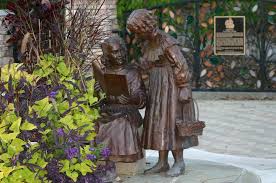

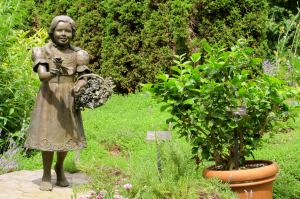 Lovely sculptures inhabit the property, none of which were probably there when the sisters lived there. One is a sculpture of the two of them as teens in the “Sisters Garden” which is meant to look like a miniature farm. The art piece which struck me the oddest was Sky Woman on a turtle. I believe there is a Native American story behind this as the woman appears to be of this background. There is an Iroquois story book you can get online called “Sky Woman and the Big Turtle.” The tribe was once found along the St. Lawrence River in New York. Perhaps the sculpture was based on this story (I didn’t find a reference to it at the park). I would love to get a smaller version of it though as it is very beautiful and unique. I am sure my friends in the Sand Play Therapists world could have a day discussing this.



 Jeannine Vegh