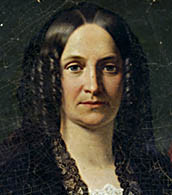
1878: Born: Maude Edith Comstock on August 11, 1878, in Middlebury, VT to Orvis Foster Comstock and Mary Severence (neé Hickey). She was the last of seven children and only three of which survived to adulthood.
1892 – 1896: Attended Middlebury High School. (approximate years)
1896: Normal School department of the Vermont College at Saxton’s River, Windham County. (approximate year)
1900: Became a teacher in Middlebury and then at St. Johnsbury, Caledonia County, and then in Rockland, Massachusetts. (approximate year)
1902: Principal of a grammar school in Rockland, Massachusetts. (approximate year)
1903: Married Walter Gustavus Waitt (aged 25), on June 25th, in Melrose, MA.
1909: Gave birth to Doris Ida Waitt (aged 31), on March 7th, in Fremont, OH.
1912: Ohio Constitution gave cities right to frame their own suffrage charters and create municipal offices.
1912:Women’s suffrage on Ohio ballots but defeated.
1914: Maude and Walter and Doris move to Lakewood, Ohio. She was a school teacher (age 36).
1914: Women’s suffrage on Ohio ballots but defeated again.
1917: Lakewood passes municipal suffrage in part due to Maude, C.E. Kendall, and Bernice Pyke. Women in this district were allowed to vote on municipal issues.
1918: Chair of Lakewood’s Women’s Suffrage party (aged 40).
1918: Sold $800,000 worth of Liberty bonds in the fourth drive as per article Lakewood Press, 10/18/1918.
1921: Elected to City Council of Lakewood (aged 43), resigned a year later as she was elected to the State Senate.
1922: Lakewood League of Women’s Voters is formed by the Women’s Civic League (organized in 1920) after gaining the right to vote. Now the oldest league.
1922: One of the first of six women elected in the Ohio General Assembly as a State Senate. She was a Republican and served three terms (aged 44), which is four years each.
1923: Introduced Senate Bill 130, Senate Bill 138, and Senate Bill 252 – all of which were signed into law.
1926: Re-elected State Senate (aged 48).
1930: Re-elected State Senate (aged 52).
During the three terms sat on these Senate committees –
Benevolent Institutions (chair)
Prison and Prison Reforms (chair)
Library (chair)
Public Health
Commercial Corporations
Soldiers and Sailors Orphans’ Home
1935: Dies in Lakewood, Ohio (aged 57) after a long illness.
Senate Bill 130 dealt with the sale and conveyance of portions of Cleveland State Hospital. The bill was initially passed by the Ohio General Assembly on April 6, 1923, but the Governor at the time did not sign the bill. On April 28, 1923, both the Ohio House and Senate declared the bill “passed – notwithstanding the objections of the Governor.”
And SB 138
Senate Bill 138, sponsored by Sen. Maude Waitt, allows the State Medical Board to appoint visiting teachers for recognized schools of nursing. The bill was passed April 6, 1923.
SB 252 via The Ohio Legislature website which only shows current information.
This is to require schools to prevent sudden cardiac arrest (aka Lindsay’s law).
Special Note: This birthday is based on the Hulbert Family Tree on Ancestry.com. There is a sister before her born on August 11, 1874, known as Ester Maud (w/o and e) and so many biographies incorrectly use a different year. The actual birth certificate of Maude Edith could not be found, only her sister.
The following is an article written by Maude C. Waitt (under her married name Mrs. W.G. Waitt). I found this on The Ohio Channel but as they did not note what paper it came from and I was unable to track this, I could not say which periodical it is from. Having said this, I would say it is from one of the Cleveland, Ohio (Lakewood) newspapers as she lived in Cuyahoga County. Ms. Waitt was the first female state senator. The Ohio Channel did note that the date this was published was on January 21, 1921. I have not edited this save for a missing quotation mark by the paper.
A Dream and What Came of It by Mrs. W.G. Waitt
THE DREAM
Last night I dreamed a dream and beheld a vision.
I thought I stood upon the shores of a great inland lake and a fair and beautiful city stretched before me.
And as I looked I saw in many homes – on many streets groups of earnest faced women who seemed to be intent on studying something. And ever and anon they would lift their eyes to messages which shone with a pure and wonderful radiance.
And after reading these messages their faces were illumined and they returned to their study with renewed zeal.
And as I drew closer I was privileged to read these flaming messages, “Arise, women voters from the North and South and East and West in this your union together – strong of faith and fearless of spirit and pledge yourselves and all that you are to a new crusade, a crusade which shall not end until the electorate of this republic is clean, intelligent American.”
“I pledge myself never to cast a vote for any measure which has not been submitted to my intelligence and ratified by my conscience.”
“Hold fast to those high ideals of public service which have been handed down to you form women who received inspiration from the Holy Fire of Divinity itself.”
And as I stood there curious – but understanding little which I saw I turned and saw at my side an Angel of Light.
And I said to him “What are all these women studying?” And he replied “They are studying the laws of the nation, state and city.”
“But,” I said, “it seems strange to me that they should leave their homes and children to study thus together.”
And he said, “They are leaving their homes and their children that they may learn better how to protect them. It has been revealed to these women that home cannot be contained within the four walls of an individual house – that home is the community and the people who live in it are the family, and the public school is the nursery and upon the welfare of the one depends the welfare of the other. And sadly do they all need the mother touch.”
“But what use do they expect to make of this knowledge,” said I.
“They are building for the new vision where men and women work together, each administering and governing according to his or her special abilities.”
“But are they not satisfied with the long reign of man?” said I. And the angel made reply: “Many women feel that a great share of the evils of society come from one half the human race with only half the intelligence and less than half the moral power making all the laws of the world alone.
“But what does woman feel she can add to the superior knowledge of man gained the long agest through? She expects to bring quicker intuitions, better moral standards and higher ideals.”
“But said I, half in anger, “Who is this new kind of woman who dares to think she can add to the superior knowledge of man?”
“This,” he made reply, “is the new woman citizen and you behold her in preparation to take her place at the council table of the nation.”
“But who is she and from whence did she come?”
And he said: “This is she who at man’s side stood and received with him the primal curse. This is she, who at his side passed the dread angel of the flaming sword went driven from the garden.
“This is she, who unfailing, weariless and unafraid has borne with man the heat and burden of the day.”
“But she is so new, so untried, can she be trusted?” said I.
And he answered thus: “When God sent to earth his only Son in whose arms was he laid? Whose was the breast that nourished Him?”
And the beauteous vision faded and as I slept I dreamed again. And once more I found myself on the shores of the same great inland lake and the same fair and beautiful city stretched before me. And I saw earnest men and women working together and the light of mutual understanding was in their eyes.
And I saw women working in peace and concord and the light of sisterly love was shining in their eyes. And I said to the Angel of Light still standing by my side: “What is this place?”
And he said: “Heaven is found on earth and here is the city of the new vision building by men and women working together. This is the ideal toward which humanity has been struggling the long ages through – this is the city of Lakewood, O.”
AND WHAT BECAME OF IT
Because of this dream, during the month of February, 1921, a new plan for citizenship classes originating with Mrs. Waitt, will be tried out in the City of Lakewood.
Twenty women have consented to become leaders of twenty groups – each of these groups to contain twenty of their friends or neighbors.
For four consecutive weeks in February these groups will meet and discuss questions relative to the State of Ohio. Said discussion to be followed by a talk-fest and a cup of tea.
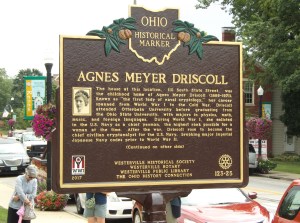
Agnes May Driscoll, née Meyer (July 24, 1889 – September 16, 1971, Leo/Athena), known by colleagues as Madame X or Miss Aggie. At first glance you might see a very timid woman in her photographs. You are suddenly caught by her eyes and this is when you realize her wisdom, strength and character. Unfortunately, Agnes is probably the most difficult woman I have chosen to write about on this blog because only one paper has been written about her and she
Beth Weinhardt
was a cryptanalyst, something I know nothing about. I am extremely grateful to
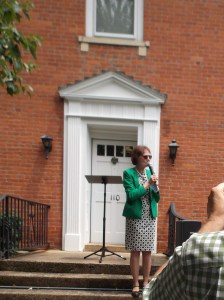
Beth Weinhardt, Local History Manager at the Westerville Library, for allowing me to spend time in their history museum reading this paper. Beth is also the writer of the “Images of America: Westerville” booklet that can be found at stores here in Ohio (but also on Amazon). This coming weekend, July 22, 2017, at 2pm, the Westerville Library will be honoring Agnes by placing a plaque outside the front of the library. The section of the library where this will be placed also happens to be the home Agnes and her family lived in until 1903. This is the time when the Anti-Saloon League purchased the property but then later sold it to the library in the 1930’s.
At the age of six years old, Agnes and her family moved to Westerville, from Illinois as her father had accepted a position at the newly opened “Otterbein College,” as a Professor of Music. Her father was Dr. Gustav Meyer, a German
Meyer family home 110 State Street.
immigrant from a town called Neustadt on Reibenberg near Hanover. Her mother, Lucy Andrews Meyer was American. The family had only three children at the time of the move to Westerville, with Agnes being the youngest but it would soon grow to a total of eight children. Dr. Meyer was also an accomplished pianist and like his father, he would share his love of music with the family. Agnes would go on to study music and become an accomplished pianist herself. Also, like her father, fluent in several languages. Dr. Meyer also ran a very strict household, demanding obedience. As you read the paper “The Neglected Giant,” 2015, by Kevin Wade Johnson of the National Security Administration (NSA), on Agnes, a deceased colleague from this agency, you begin to empathize with her personality.
Agnes was from a time before women had the right to vote. She would be 31 years old before she was able to do so for the first time. Prior to joining the U.S. Navy in 1917, she achieved degrees from both Otterbein and OSU. She received a Bachelor’s degree (listed in the paper as an A.B.) in Mathematics, Physics, Foreign Languages and Music and taught for some time. At the age of 28, in 1917, this was the first time the Navy allowed women to enlist and they were only allowed to be in clerical positions. Their view on women did not change much in her time and she was often slighted from promotions, pay raises, and dealt with heavy competition and jealousy from male peers; which caused her much distress. She was recruited as a Chief Yeoman and started with a pay of $1400/annum. This was in the middle of World War I and almost immediately she was transferred to Washington D.C. to work in the Code and Signal Section of the Director of Naval Communications.
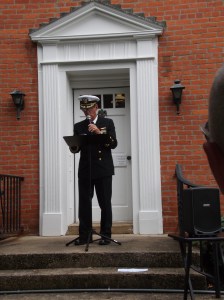
Great Nephew Captain Victor A. Meyer, (retired USN).
Her time in the Navy started out as a short period of a couple of years. She was discharged and then went back to work as a civilian but quickly left for what seemed like a promising future in the small business world. After solving a puzzle (noted as being unsolvable), in a contest put together by Edward H. Hebern, she was asked to work at his company Hebern Electric Company, at their offices in D.C. as a Technical Advisor. This was to be a small stint as the company fell apart due to issues with finances. It would be 1924 when she returned to her post as a civilian in the Navy knowing that she was going to receive a 17.5% pay cut.
At this time she was working for Captain Laurance Safford, who was to become known as “the father of U.S. Navy Cryptology.” It was also a time when Japanese and Americans were engaged in stealing secrets from each other, known as “black-bag” jobs. Soon she would be put on the task of breaking the codes from something known as “The Red Book.” It would take her three years before she was able to accomplish this. In the meantime she was training junior officers on the art of cryptology. This is about the time when her nicknames began to be formed by the men and she would be known as Madame X or Miss Aggie.
Agnes was a very refined woman, seen by colleagues as being tall and patrician, she was only about 5’ 5” which is an average height for women today, though it was tall for a woman at that time. It is mentioned that probably because she was in a “man’s world,” she was known to “curse like a sailor.” This certainly would not fit her personality based on the way she was raised and what you can gleam from her personal life. She also wore no make-up to work as attractive women were said to be in the military to marry a sailor. She would however, go on to marry Michael “Brownie” Bernard Driscoll on August 12, 1925. Brownie, his nickname, was an Attorney for the Interstate Commerce Commission. He was known to be a sentimental person who wrote poems for his wife. Brownie and Agnes loved to travel and garden and they never had children. They were close to her family and she enjoyed analyzing her nieces and nephews when they were at play, trying to determine a deeper meaning in this. She would have made a great play therapist, no doubt. The two of them loved to enter contests and gamble and Agnes was a great chess player. Her sister Margaret Eliza Hamilton, was eight years her junior. She had enlisted in the Navy during World War I as well and would end up working with her sister in the Code and Signal Section.
By 1930 the Japanese had realized the U.S. was onto their codes and so they established a new code which would come to be known as “The Blue Book.” This lasted until 1938 and then it became “The Black Book,” in two parts. However, around 1937 Agnes was in a terrible automobile accident. The driver of the faulty car would see two fatalities. Agnes had about four people in her own car but she apparently suffered the worst. She had two broken jaws and a leg that was never properly fixed so that she suffered pain and walked with a cane the rest of her life. In the video above, you can see a photo of her with her mother and what her leg looked like. Evidently she was too afraid of the surgery, which would require re-breaking the bone and probably not as nicely as the way it would be managed today with modern technology. However, this injury was known to have changed her personality quite substantially. Though the debate from her colleagues as to whether or not this was the case varies according to favoritism. At this time, she was accomplishing a great many things for the Navy meanwhile watching her peers surpass her in pay and rank. She wasn’t too happy about this.
After the accident, it would appear she had hit her peak and upon returning from her convalescence began to go on the decline in her job. It does appear though that she would be set up to fail by her colleagues, from what was written. Around this time Pearl Harbor would be attacked, to no surprise to Agnes or to U.S. Naval Intelligence (though I found it interesting to read this). Nonetheless she would be shifted to other things at this point and was no longer involved with Japanese intelligence. She would be involved with a German naval system called Enigma, in which her work came to no avail. Partly, this had to do with the Navy refusing to work with the British who had already achieved success in decoding this system. Partly, it had taken awhile because Agnes’s methods for de-coding were behind the times and she refused to keep up with them. There were machines now to help with deciphering codes but Agnes preferred to work manually (and did so the rest of her career). It was however, her only way to find the answers that she trusted. Then she was put on a project called Coral and a colleague by the name of Frank Raven, was successful at thwarting her accomplishments by sabotaging them. He was backed by people within. Agnes at this point had enemies and her cheerleaders were losing strength as they were retiring or deceased.
In 1949, toward the end of her career, she was transferred to the newly formed Armed Forces Security Agency (AFSA). It appears that she was at this point merely patronized on the job. The officers in charge had no respect for people who did not go to war directly, so she was given tasks to keep her busy during the day. From 1952-1959 she became a consultant for the NSA (National Security Administration) that was formed by the top people in the field. Agnes was still very stubborn in the way she did her work and was using a magnifying glass to pore over pages of information that took much longer to do then the machines devised to speed up the process. She did finally retire in 1959 after her 70th birthday, though no mention of this was made in the NSA newsletter.
At the end of her life, she and Brownie continued to travel, sometimes with her mother, to New England, post-war Europe and Cuba (before Castro). Agnes was fond of collecting green stamps, which gave rewards (these were before you had cards to get discounts at stores). She and her husband kept to themselves and did not socialize much, outside of a few dinner parties. They did attend lectures on astronomy and anthropology. Her mother Lucy would go on to live to be 100 years old and died in 1964. Within the same year her husband Brownie died three days before his 74th birthday. Her family noted that she was very stoic about this but stated that this was just her nature. She was known to them as an iron-willed woman.
Her sister’s stroke in 1969, which left her unable to talk until she died in 1980, would prove to be the toughest for Agnes to take. The two of them had worked together since World War I and had been close their entire lives. Agnes shared a floor at the same nursing home and would come to her death at the age of 82, in 1971. She and her husband’s bodies are interred at Arlington National Cemetery.
The reason for there being a lack of information about Agnes is that she did not keep a diary or journal. Much of what the author was able to deduce for his paper came from military archives and journals written by her peers, which happened to mention her but gave biased details about her personality. She herself is a bit of an enigma.
**The above (and below) photos are from the ceremony on July 22, 2017, honoring her with a plaque in front of the library (and her home).
Front of plaque.
Great Nephew Captain Meyer standing next to the plaque.
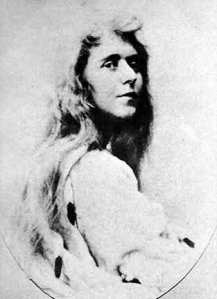
Ms. Barney (October 31, 1876 to February 2, 1972, Aphrodite/Scorpio) only lived in Ohio, where she was born for 10 years. However, I assume because her parents were both born and raised in Ohio, she is accepted on the roster of notable women from Ohio (on Wikipedia). There is also a historical marker where she was born in Dayton. Her heart and where she spent the majority of her life as a famous salonist was in Paris.
One must become idle to become oneself. Natalie Clifford Barney
I developed a love/hate relationship with Ms. Barney and trying to read 368 pages of Suzanne Rodriguez’s book “Wild Heart,” (2002) took me a couple of months. Ms. Barney is famous for saying “I am a lesbian. One needn’t hide it nor boast of it.” I have a great deal of respect for this sentence because I think the way our world is today is quite hedonistic and part of why we are in such turmoil as a whole. Ms. Barney would probably agree with me. She was a society lady, raised in wealth, appreciating high fashion and having exceptional taste. What I did not like about her is that she was a snob and if she were a man we would say she was a player. Friends, who spoke to the writer of this book described her as a very giving and generous woman. These were not her liaisons that made these observations. They documented much more painful and passionate thoughts as to her character. A player is a person who will use the word “love” sparingly and in her case as sonnets to continue playing with her web of intrigue and manipulation. A player loves the chase, like a cat to a mouse and once caught, will carry it around in their mouth until they are ready to spit it out. Natalie was known to have said “When you want to make someone crazy, you must not give in.” If she had been a poor woman, it is doubtful she would have had half of her success with friends, though she would not have been a snob.
Natalie Clifford Barney
Ms. Barney was a writer, though what I have seen thus far (very little is translated) is not quite to the level as many of her counterparts, many who were her lovers. Her salon in Paris on 20 Rue Jacob, was her child, a place where she helped create futures for young writers from the 1920’s to 1972 when she died. Some of the people who were known to be in her circle, such as Pauline Tarn (aka Renée Vivien ) the courtesan Liane de Pougy, Lucie Delarue-Mardrus, and Lily Gramont (the Duchesse de Clermont-Tonnerre). There were also very famous people (that we know today still, the others were famous then) who made their way to her “Fridays” and these were James Joyce, Edna St. Vincent Millay, Max Jacob, F. Scott Fitzgerald, Gertrude Stein, Mata Hari (entertainment), Isabelle Duncan (entertainment), Antole France, Romaine Brooks and Jean Chalon.
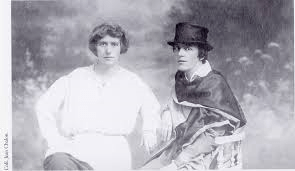
Natalie and Romaine
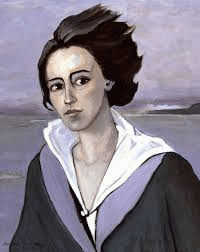
Her longest relationship was with the painter Romaine Brooks, who is now being brought back to life by many art historians. I did find myself captivated by her work when I looked at copies online. I wonder if Coco Chanel would have been intrigued as well, since they might have known each other then. Her work is black and white paintings with what is said to be incredible insight, on her part, in capturing someone’s psyche. What is odd is that they met in 1914 and it wasn’t until their mid 90’s, right before both of them died that Romaine ended the relationship for good. Of course this had to do with her mental condition that she was in at this time. My guess, from reading, is that she probably had some form of dementia. However, due to her early abusive upbringing, she had always been a bit of an eccentric and had very low self-esteem. I felt sad for Ms. Brooks because Ms. Barney was never faithful to her. I can imagine what this must have been like for her. Ms. Brooks was a survivor in some respects though. She would live elsewhere or travel abroad whenever Natalie was chasing after another skirt. Sometimes she had other liaisons herself.
Self-portrait by Romaine Brooks
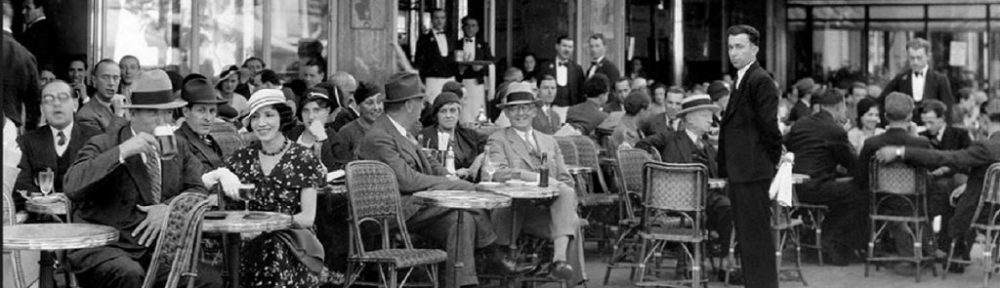
In her younger days, Ms. Barney was a horsewoman, known for her athletic abilities. What is fascinating when you read this book is reading descriptions of her pursuits of other women or networking with locals, on horseback through the streets of Paris. I found myself caught up in visualizing what this might have been like, though I have seen many period pieces that have shown this. What is funny about this book is that one might think every famous woman in Paris was a lesbian, considering her exploits. What I began to gather though, is that at this time women she chased, who were well-bred ladies like herself (for the most part) and many of them married, only knew what they were allowed to behave like with a man. Natalie introduced them to newer, more promiscuous and perhaps sometimes even safer ways to be able to express oneself. Most women at that time were more comfortable with other women. I have read in other historical books that lesbian type behaviors were actually acceptable in women’s schools and colleges. It kept them from focusing on boys but was considered natural behaviors too. Once they married it was meant to end of course and they were meant to behave in a manner fitting a betrothed spouse. With Natalie’s lovers, sometimes this happened; sometimes they continued the affair and on occasion a ménage-a-tois.
Ms. Barney’s salons were famous because of her extroverted behavior, the wonderful delicacies that she served, her choice of entertainment but also her rules. The rules had to do with not cursing, behaving appropriately (not being a jerk) and if she didn’t like you, then you weren’t allowed to come back. Agents and publishers would approach her about bringing around what they hoped would be a protégé. On one occasion Natalie invited Emmeline Pankhurst; to discuss women’s suffrage in her parlor. She listened intently but in the end was disturbed by the way their discussions and ideals turned into petty arguments. She decided at that point on not to use her salon as a political venue. This is something I could applaud her for as well. While these ladies did so much for their countries, in getting the right to vote, their behaviors kept this from happening sooner (see my article on Victoria Woodhull).
In 1927, Natalie created Académie des Femmes as a reaction to the discrimination against women in Académie Française (a group recognizing writers, but only allowing men to join). While her group did not last very long, it did bring attention to women writers. It wasn’t until 1980 when Académie Française would admit the first woman.
The last salon would occur at the cemetery on February 4, 1972 when 23 friends came to honor the passing of Ms. Barney. They realized it happened to be a Friday which was fitting this great lady and her famous salons. Ms. Barney and her sister Laura were buried together. Laura was famous for her translations in the Baha’i faith. Natalie had known that the Van Gogh brothers were buried together and thought it was ridiculous that all the marker said was “Here Lies.” As a result, Natalie prepared her own tribute which says “I am this legendary being [Amazon] in which I will live again.” Her nickname, given to her by the writer Rémy de Gourmont, after they met was “The Amazon.”
This article, originally posted here on 9/6/16, has now been posted on the Women’s Museum of CA website for their “Share Your Stories,” blog. Thank you ladies!!!
Emma “Grandma” Gatewood (October 25, 1887 – June 4, 1973; Scorpio and Artemis)
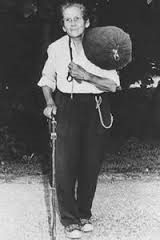
To say that she had the Gods on her side would be an understatement. This woman faced such tragedy at the hands of her husband. These were episodes of extreme violence, sexual abuse and emotional abuse as well. After she finally got rid of him, she began to heal from these inner wounds in her own individual way. A way which began to nurture her sense of self and help define her as a woman. By an act of purpose, she became an accidental celebrity. A gift that she did not wish for but would allow and come to expect after a while. Emma Gatewood, aka Grandma Gatewood on the A.T. (Appalachian Trail) would be the first woman to walk the trail in 1955 at the age of 67. She would continue to walk the trail two more times as well as the “The Oregon Trail,” and quite a few other long hauls.
I was turned on to this story, just this past year, after learning about a documentary made in her honor. A documentary which features two of her daughters: Lucy and Louise, the youngest of the clan. After watching the documentary, I saw Ben Montgomery’s book “Grandma Gatewood’s Walk,” lying on the table and picked it up to scan the cover (P.S. 8/26/2018 – see NYT article at the end of this blog. Ben Montgomery evidently was her great great nephew). This book was a New York Time’s bestseller and written by a Pulitzer Prize Finalist. After purchasing it, I had put the book to the side, thinking it would be a dull day to day journey and not quite that interesting. I assumed I would force myself through it so I could review it for this website. Naturally, I was pleasantly surprised to find that this book was full of intrigue; rich in historical content from that time period and of course her background.
Being a woman from Mercerville, Ohio and having lived in Gallipolis and some small
First Four of 11 Children
towns in West Virginia with her husband; it is not unusual to imagine a story of abuse and desperation. Not quite a story of poverty, when you had a woman like Emma but finances were plucked away because her husband was just a really bad man. I am not putting too much emphasis on him because it is a typical jerk of a husband story. You can read the book to find more. These types of stories are so compelling and what old country music tried so hard to explain to us. She would have eleven children, 24 grandchildren, 30 great-grandchildren and one great-great when she died at the age of 85.
Ben creates a rich experience of the trail that you feel as if you are walking right along with her. Thanks to her journals, newspaper articles, and letters written home, he was able to piece together what life on the trail was actually like for her, on a daily basis. In the meantime, his research uncovered one of the largest hurricanes of that time “Hurricane Connie.” He was able to show us the devastation in towns she had already left behind as well as how it affected the path in front of her. He spoke of civil unrest of the times while talking about the night she spent with two opposing gang leaders from New York, unaware yet sensitive to her surroundings. His story created a depth by showing us her own trials and tribulations on the road and yet, no matter what, she persevered and kept moving forward “one foot at a time.”
Her Gear
Reading this book, I kept thinking to myself “Wow, the Gods sure wanted her to be the one.” I also kept imagining the pain she must have been in with a simple pair of tennis shoes. I imagined what her feet must have looked like. As a smaller hiker myself (up to 15 miles), I have seen my own feet after wearing hiking boots. If they aren’t just right, you can get callouses, blackened toe nails, and bloodied heels – all of which I have had. I heard about the throbbing pain she suffered toward the end – with her knee beginning to give out. I have, at 54, problems with my legs which give me trouble if I walk too much on sidewalks or in shopping centers. I could imagine what it was like after her glasses broke (also toward the end) and she could barely see ahead of her. What amazed me most was that a 67 year old woman, having birthed eleven children, was able to sleep on a bed of leaves or hot rocks to warm her back. I have only had one child and my back does not allow me to sleep on anything but a mattress and this is not for vanity. I certainly would have a hard time getting off the ground after an eventful night’s sleep (her sleeps outside were rarely good ones due to nature, not her back). The bitter icy temperatures up in the final mountain range, any of us who live in cold weather climates – such as Ohio – know far too well what it would have been like wearing a rain coat and a few layers of clothes. But she made it and is now a legend.
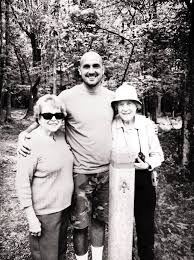
The Writer with Louise (L) and Lucy (R) on the trail.
As you can imagine, I am not racing to get to the trail and step in place behind her. I’ll keep walking my 6-10 miles with my local meetup group. I wouldn’t mind walking the Grandma Gatewood trail again (I didn’t know I had been on it when I was at Old Man’s Cave). The writer, Ben Montgomery did walk the majority of her trail and did so by tracing the original path she would have taken, thanks to her notes. This is because the trail she took was much more intense and less user friendly than the well-paved and marked trail of today. I was impressed by his dedication to doing so. He was definitely not a wimpy writer, hiding behind his computer.
So, very sadly, I must put this story behind me as I do with all the women that I have begun to research for this blog and begin to search for another amazing tale. After finishing each woman’s article, I feel as if they have just died for the first time. I tend to be on the verge of tears as I finish the book and write the article as I know I must say goodbye and move forward. I have gotten to know some amazing women that no one really has much intimate knowledge about, with the exception of what little is there to read. When I went about bringing this website to people’s attention, I had no idea just how few resources there would be about Ohio Women’s History. It is important to showcase their lives and make sure that young women have heroines, someone to look up to and imagine being like. Important that they understand, women have done so much more than get us the right to vote – which is all most people seem focused on. We are in a generation of slackers, people who would have the same physical problems I have from sitting at their desk for hours in a day staring at a CRT. Ben’s book talks about an article a man wrote which addresses the laziness of society (back then), due to the invention of automobiles. It mentioned people driving for only two blocks to get a bar of soap. I can’t imagine what that man would think of today’s society. His story was telling and a bittersweet call to arms before life became as it is right now.
The story of Emma Gatewood is the tale of many strong farming women who were capable of accomplishing multiple tasks in one day. My own research into women’s history reminds me of the book, “They Saw the Elephant,” which are diaries and stories about women crossing the country with their families, to find Gold in the hills of California, around the time of 1849. Unless these women documented their experiences or someone decided to walk a trail, these other women, unsung heroines, are people we will never know. Except of course if our grandparents made sure to put them in our heads – and we listened and paid attention to those stories. Otherwise, they are long ago and forgotten because now, in their place, are the modern vamps of our time who can sing a song or look pretty on the screen.
Note: Below is the Grandma Gatewood Trail at Old Man’s Cave, where a placard is there mentioning this. This trail was her favorite hike.
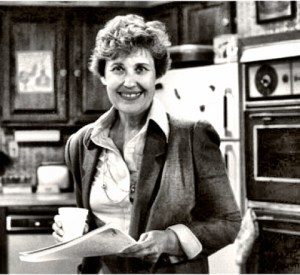
Erma Bombeck (February 21, 1927-April 22, 1996; Pisces and Demeter).
I remember reading Erma’s writings in Good Housekeeping, because I read anything my mom had on the bookshelf or lying around on the coffee table. She was writing for housewives which I was far from becoming but I still found it funny. I could imagine those things happening to women because I did a lot of housework, cooking and taking care of younger brothers myself. I wasn’t much into reading newspapers but I did follow her on occasion when she would appear on television from time to time or there would be an interview with her. Recently I thought about her again, though I can’t recall where I had read her name. It is so difficult to find books written exclusively about Ohio Women but I knew there would be one about her. And so I read, “A Life in Humor,” by Susan Edwards 1997.
If you ever wanted to understand the struggles of being a writer, than this is the book for you. While celebrities, big and small, seemed to have easy lives’ to a young woman like myself hers was certainly not one of them. Losing her father at a very young age of nine and having to live with her mother and grandparents. She might have been a “famous” tap dancer had she not been so keen on being a writer. She wouldn’t have been a writer either had she been the type to give up easily; practically failing out of college her first time out. Instead, she chose another college which appeared to be the right fit for her both academically and matrimonially. It was at the University of Dayton that she began her career at a newspaper office and met the man who would spend the next 47 years with her.
After a struggle to become pregnant and the stress of suburban housewifery, begging to look like them; she decided to adopt after two miscarriages. Then as fate would have it, no sooner had the little girl been brought into their lives, she successfully carried a child to term and then another. In the meantime she and Phil Donahue, a neighbor from across the street, began to have burgeoning careers.
Erma’s career was a struggle, partly because she was a woman and because she was dedicated to being a mother. Yet no matter what choices she made, the artist was a natural and eventually she would become a syndicated columnist writing three articles/week that would be seen around the country. This led to magazine articles such as the one I saw in Good Housekeeping.
She was approached by Doubleday to create a book which was a collection of her articles and the entry into published book writer began. Though Doubleday was not so keen to take her up on her fiction ideas, a salesperson there by the name of Aaron Priest was a great fan and saw the potential. It was through him that she began her career as an author. Before she died, she would pen eleven books and all from a typewriter. One book was made into a movie which starred Carol Burnett but unfortunately did not do well at the box office. Below is a four minute segment of this movie and I also began watching the movie on YouTube and easily saw what happened. It had funny lines (very good actors) but in between a lot of work had to be done to carry the long scenes. While it perfectly shows a typical family of the late 70’s early 80’s it is like a reality show without a producer creating conflict between the characters. Just a typical long day in the life of… It would be something I might download and watch on a Sunday; when it is raining outside.
Her first movie debut didn’t do to well but suddenly she was approached to write a play and then a TV show. The TV Show was called “Maggie” but this didn’t make it past the eight week pilot season. There is a trailer for this on YouTube but no dialogue, just credits and scenes of the opening bit for the show. It had a lot of actors who later became much larger on screen, but this wasn’t their big debut.
I found it ironic that fate put her into the hands of a kids camp for cancer survivors, in Arizona where she and her husband had moved after his retirement. The woman who ran this camp wanted her to bring some humor to the children. It wouldn’t be too much longer before she herself was claimed as a cancer survivor by having a mastectomy. Shortly after surviving this a kidney disease which she had inherited from her father began to show its ugly head. After waiting a few years to get a transplant, she died from complications that occurred after the surgery in a San Francisco hospital.
I found a quote from her that I especially loved, which was noted in this biography by Susan Edwards.
I get people who tell me they want to write, too, but that they have this house, and they have these kids, and they have that car pool. Listen, the priority has to be this, right at the top. People can’t put their dreams in a little box and take them out and play with them from time to time. These are people who are afraid to put it on the line.
If you are a writer, there is a writer’s conference annually called the Erma Bombeck Writer’s Workshop at the University of Dayton.
The most important thing to take from this book was the level of modesty shown by this great lady. While she had a bug in her that just wouldn’t stop her from writing, she never let it go to her head. As I once learned years ago at a writer’s workshop in California, and I don’t know that I have the quote word for word, “Your only as good as the last book you have written.” She was an Ohio woman who never took one day for granted.
If you are like me, you have a collection of women’s history books on your shelves. My most recent find is, Ohio’s Remarkable Women, written by Greta Anderson (Columbus School for Girls Alumni) and Revised by Susan Sawyer (2015). I have several women’s history collections and now one that focuses exclusively on Ohio women or women who’s contributions were specific to or began in Ohio. Here are the ladies you will find in this book:
Frances Dana Gage – Social Reformer
Harriet Beecher Stowe – “The Little Lady Who Made a Big War”
Eliza Jane Trimble Thompson – Mother of a Crusade
Mary Ann Ball Bickerdyke – The Nurse Who Outranked General Sherman
Victoria C. Woodhull – Avatar of Free Love and the Vote
Hallie Quinn Brown – A Builder of Schools
Annie Oakley – Little Sure Shot
Helen Herron Taft – White House Bound
Lillian D. Wald – Founder of Public Health Nursing
Jane Edna Hunter – A beacon for the Black Working Woman
Florence Ellinwood Allen – A Woman of Justice
Ella P. Stewart – Trailblazing Toledoan
Lois Lenski – Collaborator with Children
Dorothy Fuldheim – Cleveland’s Media Doyenne
On the first few pages, there is a map of Ohio which shows the cities that will be mentioned in the book so you can see where some of these smaller towns are and have a sense of what part of the state they are in. This is a very small 155 page book so it doesn’t come close to all of the women from Ohio who have made history in or from our great state. My intent is to bring to life so many more valuable contributions on here. I believe this book is part of a series of other books on women from other states. The series itself are titled “More than Petticoats,” Remarkable [insert State] Women.
My favorite new story, from this collection, would have to be Dorothy Fuldheim or the best which was saved for last. Dorothy was a Jewish woman who faced Adolph Hitler, as a journalist, and before the concentration camps had begun. He was just rising to power and beginning to speak on anti-Semitism at his lectures. Dorothy, who spoke German, was in Germany and out of curiosity travelled to Munich to get a chance to interview him. She was struck by the comments made by several Germans she had met while travelling in Europe about all the jobs Hitler was going to bring for the people. Naturally she wanted to know who such a person was. She used flattery at his office, to get him to talk to her and then was taken aback, once more by what he had to say, not knowing she of course was Jewish. When she returned to Ohio, she tried explaining to people the concerns she saw in this new leader but everyone she spoke to decided she was being overly dramatic. She went on to host “The One O’Clock Club” on the radio and continued her journalistic career through several other media outlets as well. What fascinated me the most was her respect for freedom of speech. This was shown by a quote she put over her guests chair (on the radio station) which read “I may disapprove of what you say, but I will defend to the death your right to say it.” This is certainly not shared by journalists of today and it is quite sad considering it follows as our first amendment rights in the constitution. Instead we see emotionally damaging words against people who are merely standing up for what they believe in.
If you have a chance, be sure to pick up a copy of this wonderful little collection and add it to your women’s history shelves. I think you will be glad you did.
At my visit to Adena Mansions, I was told by the guide that Sarah was what we would call a feminist today, as she was a champion of women’s and children’s rights. I learned there was one book written about her In Winter We Flourish by Anna Shannon McAllister (1939), and I set about to find it and read it to learn more about this great woman. Some heralded her as an American Queen, though she only wished to be known as a queen in Heaven.
Sarah Ann (May 10, 1800- February 6, 1877; Taurus – Demeter) was the second daughter and child of Thomas Worthington, sixth governor of Ohio, also known as “The Father of Ohio,” and Eleanor Swearingen. She grew up at Adena Mansion with nine other children and a whole system of laborers to monitor the estate but who were also thought of as family. Her parents were devoted to each other and to their faith. A precocious young girl who enjoyed having fun yet she was also studious and appreciated rules and order. She was a linguist and would come to speak Italian, German and French. Her early beginnings in the arts were as an accomplished pianist who was often invited to give recitals during social gatherings. As a woman she was pious beginning her spiritual pilgrimage as an Episcopalian and later converted to Catholicism in 1855. She was a good woman, a good wife and mother and later a patron of the arts, as well as a philanthropist, in general, who not only gave to charities, began them.
Firstly, she became a wife five days after her sixteenth birthday and this was to Edward King who became an attorney and opened his own firm in Cincinnati. He was also twice the Speaker of the House of Representatives and he founded the Cincinnati law school (now known as the University of Cincinnati, College of Law). While she would have a wonderfully devoted marriage as her parents, there was great disappointment in her attempts at child bearing. She gave birth to five children but only two survived. This would be Rufus and Tom but by her death, only Rufus would remain as Tom only lived to be thirty-one.
While married to Edward, she began utilizing her time and money to help those less fortunate. This started in 1832 when she helped aid families during a flood in Cincinnati. During that same year there would be a cholera outbreak and Sarah would help nurse the sick and even opened a portion of her home to house some of the worst cases. This was a bit surprising as her husband, from all his travels, was in another part of the home suffering from malaria. In 1833 she opened the Protestant Orphan Asylum which by 1939 was located in Mount Auburn (It is assumed this is now closed, as there is only a reference to another establishment built in 1849 online).
The passionate love of 20 years would end on February 6, 1836. Sarah, being a strong woman, used her period of mourning to follow her sons to Cambridge and opened the upstairs of her home to other young boys also attending the university. After graduation from Harvard, one son, Rufus would follow in his father’s footsteps and open a law office in Cincinnati. Tom began a practice in Philadelphia and his mother remained there as she was not yet ready to return to the home of she and her late husband. Both her sons would marry within two years’ time.
Eight years after the death of her first husband, she would marry William Peters. She was now forty-four years old and he was considerably older than she. They would stay married for almost 10 years until his death in 1853. It is through this marriage though when she begins to flourish more in her contributions to women and children. She was devoted to helping women acquire skills so that they may be able to have economic independence. Her first attempt to start an organization for seamstresses failed, for unknown reasons, noted by the author in the biography. Incapable of giving in she went on to open a home for delinquent girls, Rosine Association for Magdalens (a Quaker society home), which appears to be what might be called a trade or vocational school today.
Her next project was to begin the Philadelphia School of Design in 1848. Here the women created domestic creations through textile design of wallpaper, carpets and other household needs. This was significant, not just for helping create careers for young women but because, at this time, most of these items were imported. It also gave special meaning to these women, who, at this time could not own property or have the rights to their children. This college is now known as Moore College of Art and Design and continues to be a woman only school. It is the first and only visual arts college for women in the United States. Below is an excerpt from her biography (page 142) which explains, in her words, the reason for founding this school.
Having for a number of years observed with deep concern the privation and suffering to which a large and increasing number of deserving women are exposed in this city and elsewhere for want of a wider scope in which to earn their living; and after bestowing much through and enquiry with reference to the means of alleviating their miseries, I resolved to attempt the instruction of a class of young girls in the practice of such of the arts of design as were within my reach. I selected this department of industry, not only because it presents a wide field, as yet unoccupied by our countrymen; but also because these arts can be practiced at home, without materially interfering with the routine of domestic duty, which is the peculiar province of women. Sarah Ann Worthington Peter
After tackling these projects, this is when her son Tom died. To deal with her grief she set about to sail for Europe, with his wife and children assuming her husband William would join her. This did not happen. After she returned from her trip, which lasted over a year, he would die a few months later.
Before returning to Europe the second time, she would start the Ladies Academy of Fine Arts in Cincinnati where she had now moved back to. This does not appear to still be in existence. A bust of her likeness was placed in the Cincinnati Art Museum (however a return email has not occurred to verify as to whether it is still there). Sarah would end up touring Europe six times and spent much of this time procuring art for the museums here in the U.S., meeting with several popes and other church leaders, and soon began to become a bit of celebrity whose name could be seen in various newspapers wherever she might travel. The latter aspect she did not enjoy very much. Through these travels and the delight she would take in the rites and rituals seen amongst the Catholics, as well as her conversations with these holy men, she converted to become one of the followers herself.
Toward the end of her life, she had given quite a bit of money to various convents and to the church itself. She also established some of the orders in the United States. At the age of 77 she was surrounded by her son Rufus and his wife Minnie, Sisters Martha and Antonia and a local priest. The final portion of her Eulogy found on the last page (381) of her biography and given by Reverend Edward A. Higgins, S.J., and Rector of Saint Xavier’s College was distributed as a leaflet to those amongst the funeral mass.
Nature had indeed been generous in bestowing on Mrs. Peter qualities seldom found united in the same person: a bright, keen intellect, a warm, loving heart, untiring energy, and a soul utterly devoid of selfishness. Her mother’s heart was filled with the tenderest love, the most touching solicitude, for her children and relatives. She had the kindliest and a generous relief for every form of distress. ‘God gave her largeness of heart as the sand that is on the seashore.’ All will cherish her memory, and profit by the beautiful example of her virtues. May she rest in peace. Amen.
There are many other projects and duties that Sarah took on and if you would wish to read further, I would recommend obtaining a copy of this very old book (Abe Books or at a library or other used book store). Having read the majority of this book, it is not very entertaining as it is all factual rather than story, I found her to be quite a woman. It is ladies like these that you can’t imagine ever doing anything wrong and certainly making no enemies. She walked a path of servitude that seemed to increase with age. While her father is the one who is revered in our state, women like Sarah should not be forgotten. It continues to astound me as to how little has been written about these great women. We can find so much written about royal ladies but so little about the contributions of women in history, of lesser but certainly not without means. Of course even those with little means at all, we have abandoned even more as their letters and other writings have not been set aside for posterity as would a woman’s like Sarah.
If you love history and happen to be in Ohio, or visiting, make plans to visit the Adena Mansions and tour their grounds. I believe there continues to be a couple hundred acres left so there is more than enough room to take a stroll around the property.
A Frequent Blog of Devotionals Inspired by A Course in Miracles, A Course of Love, The Way of Mastery, Choose Only Love--Plus More . . . with Celia Hales - https://www.amazon.com/author/celiahales





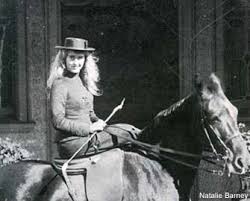 the streets of Paris. I found myself caught up in visualizing what this might have been like, though I have seen many period pieces that have shown this. What is funny about this book is that one might think every famous woman in Paris was a lesbian, considering her exploits. What I began to gather though, is that at this time women she chased, who were well-bred ladies like herself (for the most part) and many of them married, only knew what they were allowed to behave like with a man. Natalie introduced them to newer, more promiscuous and perhaps sometimes even safer ways to be able to express oneself. Most women at that time were more comfortable with other women. I have read in other historical books that lesbian type behaviors were actually acceptable in women’s schools and colleges. It kept them from focusing on boys but was considered natural behaviors too. Once they married it was meant to end of course and they were meant to behave in a manner fitting a betrothed spouse. With Natalie’s lovers, sometimes this happened; sometimes they continued the affair and on occasion a ménage-a-tois.
 I was turned on to this story, just this past year, after learning about a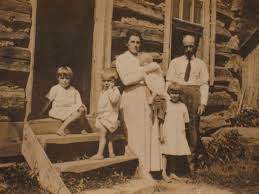

 Erma Bombeck (February 21, 1927-April 22, 1996; Pisces and Demeter).