Lucy Stone – Oberlin College

August 13, 1818 – October 19, 1893 (Leo and an Artemis Archetype)

Lucy Stone was born and died in Massachusetts but what is important about putting her on an Ohio Women’s History page is her contribution to women which began to surface during her time at Oberlin College, in Oberlin, Ohio. While she was the next to the last of nine children, this did not distract her from becoming a leader and a survivor (you often see this amongst the eldest children). Observing how women were left to the mercy of men, as a young child and seeing that it was not to protect them but to take power over them, she decided she would never marry and would take care of herself. She was also distraught over the fact that the Bible included passages that re-enforced misogyny and this gave her reason to be spiritual frustrated. Naturally this was the sign of the times and so I am not putting down men of this time period, only showing how a woman from this time period made a name for herself and survived the obstacles of the period.

As a teenager she began her road to independence by teaching and soon learned that she was being paid less than what men received. Back then, it was a dollar a day! And people complain now about trying to make a living. Over the years, Lucy began to research women’s issues since the topic of women’s issues were just starting to appear in local newspapers. She attended abolitionist rallies and conferences and was impacted by the “Letters on the Province of Woman”, which would later change its name to “Letters on the Equality of the Sexes.”

Her education began at Mount Holyoke Female Seminary at the age of 21 but she left as quickly as she arrived when she learned that the Dean was in favor of slavery and not to keen on women’s rights. She then went on to Wesleyan Academy. It was here that she began to find solidarity amongst women and would follow the lead of a young woman, Abbey Kelley, an anti-slavery agent who tried in vain to speak up and make her voice heard. At the age of 25, after hearing that Oberlin College was one of the first of its kind to admit women and African-Americans, she hopped on a train and began her journey west to Ohio.

At Oberlin, she had a lot of high expectations for women on campus, a natural assumption. Unfortunately, she was wrong. She again was paid half what the male students were being paid for school type positions meant to pay expenses. She was having to do double the work of male colleagues and her health began to wane. She fought with the school on this and after a number of students supported her on this, she won.

At the same time, she was fighting to be a public speaker, which was not allowed for women at this time. What Lucy wanted to do was begin by approaching women’s issues on the platform. Amazingly, the men in her family supported her but the women did not.

She graduated Oberlin at the age of 30 and went on to continue speaking  and petitioning about women’s issues and anti-slavery. Other items of interest were that she kept her name after she did eventually marry and she wore pants (under her dresses).

To learn more, the only book I was able to find about her was “Lucy Stone: An Unapologetic Life“by Sally G. McMillen


Appalachian Women

This is an amazing documentary of women who are called “Appalachian.” While these ladies are not from Ohio, their kinfolk migrated here over the years and settled around our fine state. You can still hear the dialect amongst certain elder women, here in Ohio and a hint of this talk from others. A wonderful lady I grew up with, used these words:

Arn – Iron

Wharsh – Wash

Davenport – Sofa or Couch

Arnge – Orange

“Well, for heaven’s sake.”

Perhaps you can recall some words that gave you a smile as well. I once worked with a client down in the Wilmington area that had such a thick dialect I often had to ask what he was saying because I had never heard his way of speaking before.

What I find superior amongst these women is their ability to be a survivor. These are ladies who would never ask for a handout from the government because they already know how to make do with what they have. If they don’t have it, they can grow it, bake it, sew it, or fix it. This is a skill that most women do not know today and could not do if their lives depended on it. I believe there will come a time when this will be necessary.

Cherish your elders while you have them. They may seem old fashioned and strange now but I guarantee you that as you age, they will make more and more sense.

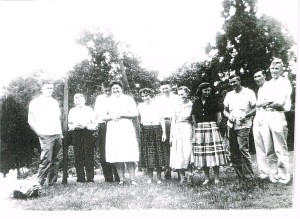
Appalachian Family transplanted to Grove City

Appalachian Family transplanted to Grove City

The same Appalachian family c. 2001 L-R Joe, Elsie, Bob, Della and Bernie Wells

The same Appalachian family c. 2001
L-R Joe, Elsie, Bob, Della and Bernie Wells

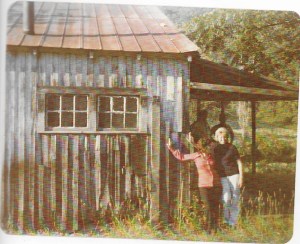
Appalachian family home KY c. 60's or 70's

Appalachian family home KY c. 60’s or 70’s

This old house was where Della and her kin lived in KY, estimated time would be 1930’s-40’s and back. This home was a three room place for a sharecropper and his family. It had a big living room, a fireplace, a big bed in the living room, the bedroom had 3 beds, there was a big kitchen and a long table with chairs made by Della’s father. Three kids slept in each bed and parents were in the living room. In order to find this home, Della and her husband had to work hard traipsing through weeds and looking out for snakes before they were able to find this and take a photo.

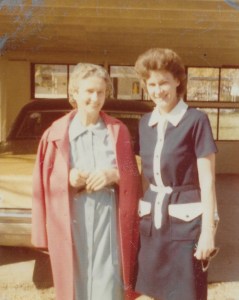
Mom (Della's mother-in-law but what we called her) and Norma Jean Welsh 1974

Mom (Della’s mother-in-law but what we called her) and Norma Jean Welsh 1974

Mom and Norma Jean are standing in front of the garage for their home and Della and Don’s home. Behind the windows is Della and Don’s home and in front of them (which you can’t see of course) is their home. It was a two car garage and attached to it is the original home that Don and Della lived in before they built the home behind the window. The original home was a one bedroom house that I vaguely remember from peering through the window from time to time. It had no bathroom and so Della, Don and the two girls had to go to Mom and Norma’s for hygiene.

Women’s History

It is very important that we look at both women and men of history. If not, we are only getting a one sided approach to the story. When I first took Women’s History it was at Santa Barbara City College in the early 90’s. The first thing our teacher had us do was to write down 10 women in history who were not celebrities or first ladies. She knew this would make our job much harder. This was very important because very few people in the class could think of 10 women. Aside from the typical names such as Clara Barton, Betsy Ross, Florence Nightingale, this was really what we knew, nurses or seamstresses. Each week, we began to learn so much more about our history, surprises that women were involved in major historical events and yet we had never heard of them.

One of the most fascinating to me was Victoria Woodhull. I want to write a little bit more about her in the future but I thought I’d get a head start here. Victoria was the first woman to ever run for President. She is from Homer,Ohio but no one has ever heard of her. Not unless they are a woman and a professor of history. What is even more important about Ms. Woodhull is that she spearheaded a campaign in front of the House Judiciary Committee. She was very convincing when she pointed out that we didn’t need to “re-invent the wheel,” so to speak because the constitution did not say women could not vote. Things were turned upside down though because the heads of the Women’s Suffrage Movement, were pretty upset with her because she had been outspoken about one of their brothers who had cheated on his wife and happened to be a minister. This bit of history gets me so upset more than anything else because it is where you see that women have big ego’s, just like men do. These women made sure to overturn the minds of the already convinced men of the House Judiciary Committee and turned Ms. Woodhull’s appearance into a joke. What is the cliché? Wagging the Dog? Ms. Woodhull was also very very much ahead of her time. She was  what we would call today a hippie mindset. Back then, it was un-mannerly, not very lady-like. She believed in free-love, was a psychic and ran a commune for some time.

It is amazing when you think about the fact that it took us almost 100 years from the beginning of the suffrage movement until the 19th Amendment was passed in 1920. Ms. Woodhull would have decreased this substantially. It is this story I like to share with women when they say that we are better at being leaders and running countries and so forth and so on. No gender is better at anything, except what they are only physically capable of doing due to their gender. You can learn more about Victoria Woodhull in the book “Notorious Victoria,” by Mary Gabriel. Lots of photos in here too as well as being a compelling read.

My question next is with all these wonderful books out there that are focused on women’s history, why is it that society, here in America only seems to know about the Suffragette Movement? The movie industry seems to re-hash the concept of women’s right to vote over and over again as if this is the only thing we have ever accomplished in this country. Actresses continue to complain about no good roles out there for older women or even younger women, though are there good roles for men? Being a movie aficionado myself, I can’t even bare to watch American movies anymore because they are so ridiculous. Either focused on a super-hero, chic flicks or just really poor writing. Meanwhile, the rest of the world has no problem featuring women, young and old, in very good storylines. Not only are they doing this, they do not have Actresses who look like a Victoria Secret model either. In fact, Actresses abroad come in all shapes and sizes, just like real people. I have often questioned why these American Actresses, who make millions of dollars aren’t spending their money making good quality films with females in the lead? Telling Women’s History would be a good place to start. We can be very shallow over here. This is why I wanted to do my part in remembering some of these ladies locally, before they are forgotten by a society who seems hell bent on focusing on modern technology and cheap labor in China.

Women worked hard, alongside men to bring us where we are today and we have ruined so much of what we fought for here in this country. At the same time our history is being ruined by the politically correct studios who are catering now to this mindset that we should alter history to make sure someone gets a part so that some group won’t be offended. This means our children are not learning the truth about the past. This is wrong because there is no integrity here. It is very sad and pathetic when we lie about the past.

There is integrity in what I write because I am not trying to spare anyone’s feelings. I am going to write a person’s story in here, based on the facts that I am aware of from the research I have done. Sometimes I will point out, like I did above, that my gender has screwed up their own history and made life miserable for themselves. This is meant to be honest, not anti-women and I also don’t want to be biased. What I would like to do on this website is feature women, past and present that I have been able to relate to and who have really inspired me to put this together in the first place. It is subtitled Transformed Women in respect to my own book that is helping women to become transformed. To become women who are able to have the life they want. A life that can be theirs when they learn to ask for what they want in a wise way vs. a bitchy/Diva way and when they learn to set boundaries for themselves in the same manner. I help teach women in my book how to do this. The women I will write about here have already done their best to make this happen and have made history as a result, whether it was good or bad. Mistakes and all because no one is perfect.

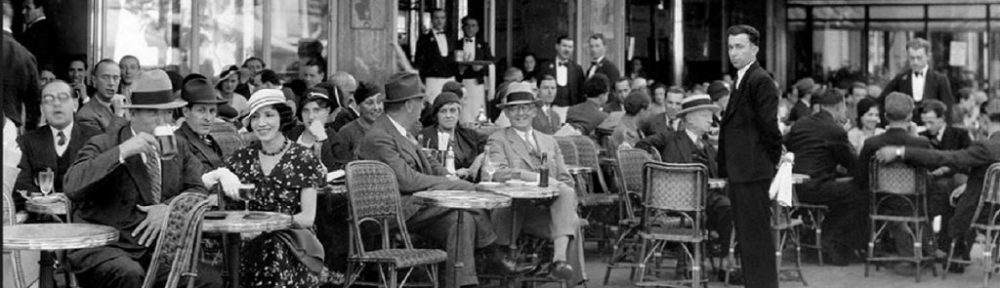
I hope you will enjoy reading some of these stories. I will also gather items off the Internet, such as YouTube videos and photos when I can find them. The cover photo for this website is a cropped version that came from the Ohio Historical Society. This is a photo of women who went to work during WWII and consequently had to go back home and become unemployed when the men came home.

If you are aware of stories of Ohio Women, please let me know about them. If you have any good books you would recommend, I’d love it if you would share this with me as well (no matter where the women came from). I am always looking for a good book to read. Thank you and welcome to my chapter of Women’s History, stories of ladies from here in my home state of Ohio.