Opal Dunn McAlister – Minerva Park and Marysville, Ohio

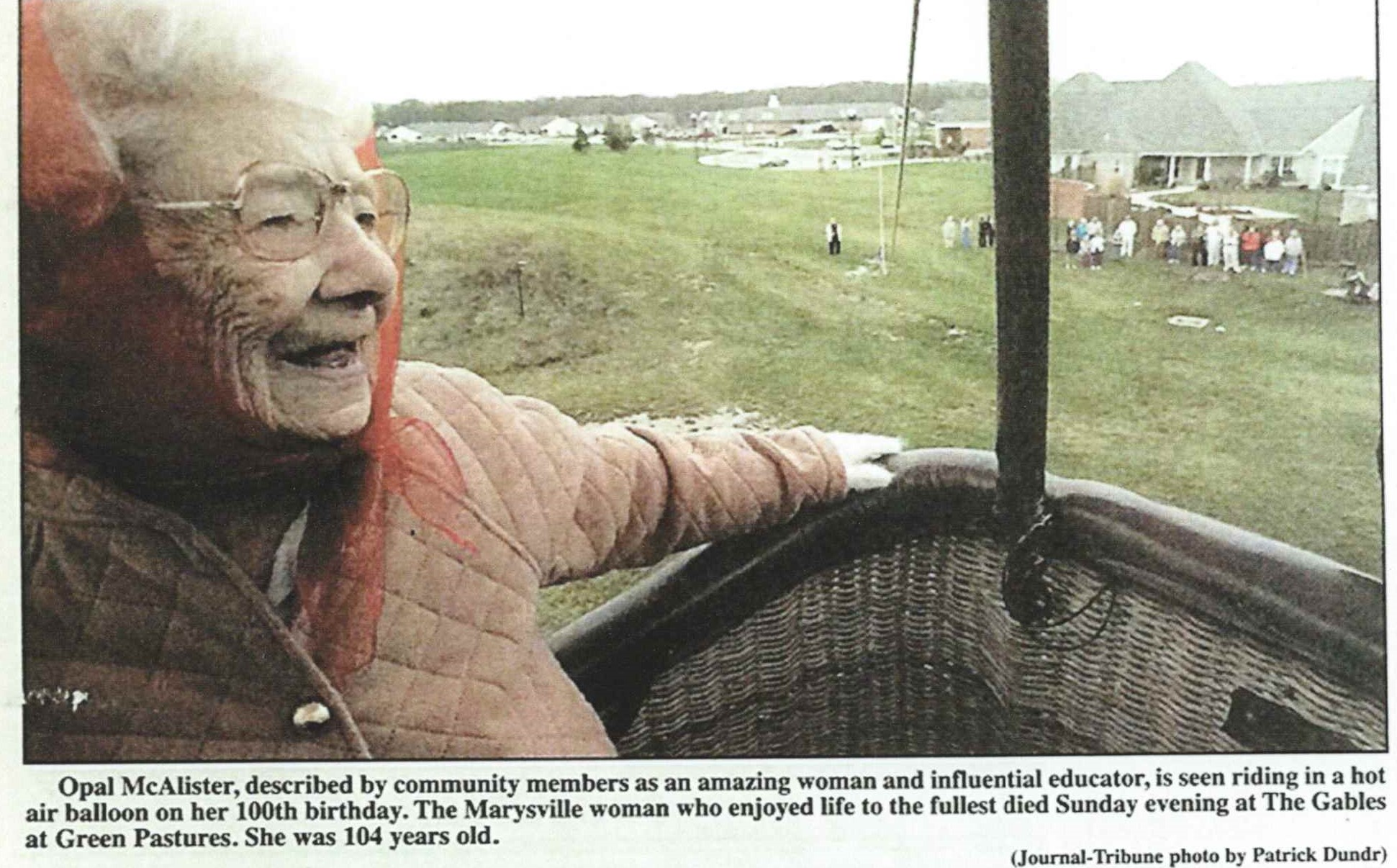
Opal Dunn PhotoOpal Dunn McAlister – November 16, 1904 to May 10, 2009 (Scorpio and Athena Archetype).

Opal lived to be 104 years old. She was not a famous woman though after coming to learn of her history, after purchasing my home, I was intrigued by her story. She was a first woman to accomplish quite a few things in her life and so it is important to note this unsung hero (as I hope to do with other women), here on this blog.

I knew that she was the first woman to live in my home but I did not realize, until I received the Auditor’s assessment list (Franklin County) that she purchased this home as a single woman in 1930 at the age of 26! On March 3, 1930, Opal L. Dunn is listed as purchasing this home for the first time from the Minerva Realty Company. At that time, Minerva Park was not an incorporated area and had only been known as an amusement park from 1895-1902. However, in 1928, the Minerva Realty Company purchased the land and put up a few homes. Not until 1940 would the area be incorporated and officially recognized as its own community. By this time, Opal and her husband Daniel D. McAlister (married later in 1930) had moved on and another couple had moved in (1939). She and her husband lived here for 9 years, though for some reason the deed only lists Opal L. McAlister changing her name on November 9, 1936.

While researching her information I was able to find an obituary from 2009 in the Marysville Journal-Tribune. They never mentioned her early time here in Minerva Park but they mentioned so many other wonderful tributes. She was “described as an amazing woman and an influential educator,” in the article. For 52 years she worked as a teacher and principal. During her time as a teacher, she taught at Watkins Public School from 1923-26 (around Obetz Ohio) and was head coach of the Varsity Boys Basketball team. From 1927 to 1942 she began teaching in a town called Flint, which was a village that housed the Westerville Railroad station but is actually in Worthington now. I looked this up and it appears that the abandoned school is still standing on Flint Road and Park Street.

During World War II Opal had entered the Army voluntarily in 1942 at the age of 38 in Des Moines, Iowa. She was part of the Women’s Auxiliary Army Corps and earned the rank of Second Lieutenant at graduation whereby she was given the task of training women for work overseas. At the end of her career in 1946 she held the rank of Captain. In 2007 she was asked to give a speech during the dedication of the Union County Veteran’s Monument, on the courthouse lawn. She gave this presentation from memory.

After her term of service with the military, she moved back to Ohio and served as teacher at Ostrander School a town inside of Delaware County. By 1964 she had risen to the rank of first female principle of Ostrander Elementary School. She took a temporary early retirement in 1967 as her husband was very ill, returning to school after his death (1969) but not until 1970. She then remained a teacher until 1975.

She was also the president of the Delaware County Teacher’s Association for 20 years. Later she would hold a position in the Retired Teacher’s Association for the same county for 15 more years. The Journal-Tribune states that “She was honored for her teaching in Lessons of the Century: A Teaching Gem by Robert C. Johnston in Education Week magazine in September 1990.”

As you can see by the photo above, Opal celebrated her centennial by flying in a hot air balloon. When I saw this photo, it really said a lot about the former owner and first woman of many great things. I wish I had known her and would love to see some historical photos of my home and what it looked like when she actually lived here. In the meantime, I cherish owning a home that was originally purchased by a single woman, in a time when women just did not do these kinds of things.

Elizabeth Richter – Dayton, Ohio

The following article was found on the Dayton History Books Online Website. I thought the story was interesting as it talked about the work of some women in Dayton, Ohio at the end and into the beginning of the 20th century. I have edited it a little bit to clean it up.

The [original] article appeared in the Summer 1967 edition of the Montgomery County Historical Bulletin

MRS. HEDGES’ HOUSE

By Roz Young

 It makes a sensitive person heartsick to see the wrecking ball of progress reduce a fine old building to rubble. Regret for what once was and cannot be again is no stranger to any of us.

But when the area known as the Haymarket was bulldozed into crushed stone and splinters and finally open land by the progress of urban renewal not long ago, nobody shed a tear or raised a protest even though many a once splendid mansion of an early day was among those reduced to wreckage.

There was a time in the last part of the previous century and the early part of this one when one of the tree-lined streets in the Haymarket was as well-known as Main Street or Third. Pearl Street ran for three blocks from 1100 East Fifth to Wayne Avenue, intersected by McLain and Howard Streets. Thirty-eight houses, most of them large, red, brick, Victorian structures, lined the street besides a cigar factory, a livery stable and the city haymarket and weigher’s office.

Most of the houses were ornately trimmed; each had the name of the proprietor, a single woman posted in the door glass or permanently etched there, and at night, in the window on a table sat a red lamp, spreading its cheery invitation to all. Within the houses many women followed a profession dignifies only by its extreme age.

Pearl Street, while admittedly the most sinful spot in town, was generally a cheery place. On warm summer evenings, strollers along the sidewalks noted that every room in the commodious houses was lighted, and from the open windows came the sprightly tinkle of player pianos and the bacchanalian shouts of the happy customers.

The houses along Pearl Street, as well as a few others in town, flourished under police control. The women who pursued their calling- there were about 150 of them altogether- had first to register with the police, be photographed and take a physical examination. No known criminals or diseased persons were permitted to work in the houses; in this the police tried to preserve the city’s reputation as being a “nice, clean town.”

Through good times and bad, the houses of the red light district kept open and prosperous. Finally, however, the religious and some civic elements in the city, after a long and wrathful campaign, forced the end of legalized prostitution. The once elegant houses fell into shabbiness, disrepair and decay until at last the bulldozers moved in. Today, not a scrap of Pearl Street remains and grass grows where once some of the most elegant men in Dayton hurried with light foot toward a favored house in which to spend an evening.

In every town in every profession, a few persons enjoy the reputation of being the best. Lawyers pridefully point to their top men; doctors defer to a handful of their finest.

On Pearl Street, the queen of all the madams was an imposing individual known as Lib Hedges. She kept a house for 39 years and in all that time, no one denied that Mrs. Hedges had the finest house, the prettiest girls, and the most genteel clients. To her pleasure palace came not only, the sporty young men of the city, but also men of maturity, judges, lawyers, city officials. They came confidently, knowing that she never talked and that their exits and entrances through the back room would forever remain a secret. And they did, too. Once when one of the girls came down with diphtheria and the health department clamped a quarantine on the house, the mayor, himself, was rumored caught there for 10 days, but which mayor he was, not even the most persistent reporter could find out now.

She was born Elizabeth Richter in Germany in 1840. The details of her early life have vanished into the mists of the swirling years. But somehow, she came to Dayton and married a no-good chap who shortly left her to make her own way in the world.

She was 36 years old, a tall, striking woman with piles of red hair on top of her head, strong features and much given to frilled shirtwaists and long, billowing skirts for daytime wear and elaborate brocades and velvet for evening. She opened a saloon on South Main Street opposite the Fairgrounds in 1876, where she sold beer in the front rooms at five cents a glass and dispensed other attractions in the back rooms at considerably higher prices.

Elizabeth had flair; her customers came again and again. She soon added to her staff, recruiting only girls from out of town, being canny enough to avoid the entanglements that local girls might bring on.

For seven years she ran the South Main Street Saloon. By then she had saved enough money to build an impressive place of red pressed brick trimmed with white carved stone at 30 Warren Street near the canal. She took a partner, too; this was her younger sister who for business purposes adopted the name of Louisa La Fontaine. Louisa was 26.

Three years after expanding into the Warren Street house, Mrs. Hedges set her sister up independently in a fine house on the corner of Howard and Pearl. A red brick, also, it had on the first floor a front and back reception room, a front and back parlor, a piano parlor, dining room and kitchen. The second floor was given over to seven bedrooms. The house was richly furnished and embellished with draperies, pictures, statuary, ornamental vases and other art objects.

Oh, how the money rolled in! Lib invested her surplus in stocks and real estate; at one time she owned over 100 pieces of property in the city. She was generous. She set a fine table for the girls and personally saw to it that each one had a bank account. If any girl decided to marry and leave her establishment, Elizabeth gave her a lovely wedding and set the couple up in one of her properties. If one died, as happened a few times, she gave her a fine funeral and a resting place in Woodland cemetery.

After one of the girls died and was buried, Mrs. Hedges decided to purchase a family plot in Woodland. She bought a corner lot on the hilltop with room for 16 graves. She then had the bodies of her parents, Herman and Elizabeth Richter, reinterred there, as well as that of the girl, whose marker reads only “Lora, 1856-1883.”

Louisa’s house was also happy and thriving. But in 1893, she fell ill, a victim of stomach cancer and after a long illness during which Elizabeth stayed with her constantly, she died May 23, 1894.

She was buried on the hilltop next to the spot Elizabeth had chosen for herself, and she erected an imposing granite shaft topped by a seated figure of a weeping goddess, done in the Greek style. It is one of the finest monuments in the cemetery.

Lib was executrix of Louisa’s estate and received all her property with the exception of one special bequest which proved to be a great embarrassment to the recipient and a source of much gossip among the townsfolk.

William, Moses, Lee and Ralph Wolf were four prosperous brothers who lived with their widowed mother Sarah on Jefferson Street not far from Warren. William and Moses operated a business under the name of Wolf Brothers, General Bill Posters and Distributors. The other two, operating as Lee Wolf and Brother, were manufacturers of cigars and dealers in tobacco and confections. They also sold books, music and operated a news depot. Both companies worked out of 100-104 South Jefferson.

Whether the Wolf brothers patronized the houses of Elizabeth and Louisa, we shall never know. All are long gone. But one of the brothers certainly made a spot for himself in Louisa’s heart somehow, for the second item of her will read:

“I give, devise, and bequeath to my friend, Moses C. Wolf, of Dayton, Ohio, the sum of one thousand dollars; also my horse and phaeton and the set of harness belonging to same…I make this bequest to my said friend as an expression of my appreciation of his uniform kindness to me.”

Of her sister, Louisa said in her will: “I give, devise and bequeath all the rest and residue of my estate, real and personal, to my beloved sister, Elizabeth Richter, formerly Elizabeth Hedges, she to have, hold, and own the same in fee simple, absolutely and forever. I make this bequest in favor of my said sister and to the exclusion of my other relatives because of the intimacy, love and affection that exists between us, and because of her kindness to me in sickness and distress.” The will was witnessed by her physician, D.M. Scheibenzuber, and John M. Sprigg, her attorney.

Shortly after Louisa’s death, Elizabeth leased her Warren Street property to Clarence Gebhart, an insurance man, and moved to the Pearl Street address.

She had an eye for business. On Sunday afternoons she went for long drives in her phaeton, accompanied by several of the girls, up one shady Dayton Street and down another. They were met with uniform cold stares by the more moral women on the avenues, but it was not their glances she was interested in. It was the husbands, she had in mind, and she got them.

On Monday evenings she closed the house to take her girls to her box at the theater, usually causing as much diversion in the audience as the show on the stage. When the city fathers organized a parade to celebrate the city centennial in 1896, Elizabeth considered for a time taking a float. But she thought better of it and probably relieved a number of worries by doing so.

She permitted no coarse language or unseemly behavior in her house. Rumor has it that the only time John L. Sullivan was knocked out was in her place. While visiting there he committed some indiscretion which Elizabeth would not abide. She indicated her displeasure, so the story goes, by hitting him over the head with a beer bottle.

Another time, so it is said, one of the local patrons, in speaking of Ollie Brown one of her girls to die in service, used a coarse word to refer to her profession. Elizabeth overheard him. Picking up a fireplace poker, she marched him into the parlor where the girls had assembled and after giving him a public lecture that would make a convert out of the roughest sinner; she threatened to spill his brains on the rug if he did not get on his knees and apologize to every girl in the room. He elected to follow her request.

One evening, the girls were entertaining their young men in the front parlor. Elizabeth was reading in the front reception room. For amusement, the girls tried to see which one could kick the highest by taking turns aiming at the chandelier. One of the girls threw herself into the project with such abandon that she made an unintentional noise.

Elizabeth, tall, costumed in floor length, plum velvet, appeared in the archway, peering into the parlor through her lorgnette.

The girls congealed in their tracks; so did the young men, their laughter dying in their throats. Her gaze slowly swept the room. “What lady,” she demanded, “done that?”

Elizabeth was generous with her contributions to charity. In 1913 Dayton was struck by the worst flood in its history. Both her houses as well as 50 other pieces of real estate she owned were in the destructive waters. To clear out the mud and filth, to replace damaged siding, foundations and furnishings, to paint, plaster and otherwise restore the buildings were herculean tasks and very expensive.

An earnest worker for the flood relief committee called on her for a subscription. “Flood relief!” Elizabeth shouted. “Why come to me? I need flood relief myself, not to be asked to donate to a subscription fund!” Then she launched into a detailed account of all the damages she had suffered.

Finally she ran out of steam. “At that, I guess I’m better off than a lot of people, the poor devils.” She fixed her sharp brown eyes on the committee member who had hoped for 500 dollars but was quite willing to take even 10. “I’ll give you something,” she growled, “but it’s not going to be much. I’ll give you two thousand dollars and not another God damned cent.”

In 1915 the police ordered all bordellos in the city to be closed. Elizabeth was outraged, as were all the other madams, but since she was ever a law-abiding citizen, she closed her place at once. The others hung on for four or five years longer, in constant trouble with the police, but finally they too, closed.

She continued to live at the Pearl Street house, but in 1918 when the city directory man came around, she told him her name was Elizabeth Richter, and from that time on she used her maiden name. In 1922, she moved back into her Warren Street home. There she continued to live surrounded by her treasures of the years, her lamps, mirrors, clocks, sewing cabinet, velvet rugs, her oak furniture, her china closets filled with Havilland, her cut glass, and her Herrick Ice Machine.

On the afternoon of April 12, 1923, the following story appeared in the newspaper:

Mrs. Elizabeth Richter

is DEAD.

The funeral will be private and will be held

Saturday morning at 9 o’clock at the residence.

Burial will be in Woodland cemetery.

The death of Mrs. Elizabeth Richter, 83, a life-

long resident of the city occurred at 8:30

Thursday morning at her residence, 30 Warren St.

She was a large holder of property and owned

stock in several Dayton corporations. Her death

followed a protracted illness.

Thus, Elizabeth Hedges finally found a quiet resting place on the hilltop along with Louisa, her parents, and three of her girls, Ollie Brown, 1843-1893, Mary Anschutz, 1877-1899, and Lora, 1856-1883.

In her will, witnessed by Roy G. Fitzgerald and William K. Marshall, she left a trust fund to the cemetery trustees to beautify and keep her family plot in good condition. She left her diamond solitaire, Louisa’s diamond locket, pictures of Louisa and her own personal belongings to a nephew along with the bulk of the estate.

Cash bequests of $1,000 each went to two other nephews and her emerald ring to Charme Wright, the daughter of her dressmaker.

She left $25,000 in war stamps, 555 shares of City Railway Company, 100 Dayton Street Railway, 24 Dayton National Bank, 140 Reliable Insurance, 300 American Rolling Mill, 100 Procter and Gamble, 100 shares Fleischmann’s Yeast and $7,000 in building and loan accounts.

She left eight vacant lots and buildings located at 16 Brown St., 13 Joe, 28-30 Warren, 610 Hickory, 1601 East Third, 101 McLain, 411-413 Montgomery, 263 Chestnut, 334-340 Sherman, 323 Troy St., 38 Horton, 612 Wayne, 623-625 Wayne, and 253 South Pearl.

The appraisers valued her estate at $202,546.17.
 

Victoria Woodhull – Homer, Ohio

Victoria Woodhull – September 23, 1838 – June 9, 1927 (Libra and Aphrodite archetype)

A woman who was seen as a controversial figure in her time, was of course way ahead of her peers. She began her start in life with a family who had less than good intentions or you could spin the story by saying their way of surviving wasn’t exactly ethical or legal. She was a spiritualist, polyamorous, started a commune, in fact lived a pretty wild life. You can imagine that as a women’s suffragist, she would eventually be ostracized by Susan B. Anthony and Elizabeth Cady Stanton’s world. Today, she would have just been a normal modern day woman.

What is significant about Victoria Woodhull is that she was the first woman to run for President announcing her candidacy in 1870. Her party was known as the Equal Right’s Party and she was accepted by them as a candidate in 1872. Frederick Douglass, a former slave and abolitionist leader, was her candidate for Vice President. What is also significant is that Victoria Woodhull spoke before the House Judiciary Committee and argued that women had the right to vote, under the demand that the constitution did not say women were excluded. There was nothing new to write, they just needed to realize this. Of course by this point she had already been ostracized by the suffragist’s who certainly did not want her going down in history for something they had worked so hard for. As a result of this, while the men were in favor of Victoria’s speech and thought her argument made perfect sense to them, they were deluged with an onslaught of wives and sisters who were telling them that she was nuts and they should not listen to what she had to say. Before too long they were laughing at her instead.

This last fact is the most difficult to fathom, in this time period, as it would be 47 years, from when she spoke, before women actually did get the right to vote. It also shows how women can be vindictive and ruthless toward other women and certainly are not the “better” sex for any position of authority as they are no better than men. What you can also see is that the suffragists had developed quite a large ego. What difference would it have made who got us the right to vote, as long as we had it?

Other amazing feats are that Victoria and her sister Tennessee were the first women stockbrokers to open shop on Wall Street. She ran a newspaper, which was how the suffragists ended up going against her. Victoria ran an expose on the brother of Harriett Beecher Stowe about his infidelity. She focused on him because he was a minister preaching to his flock against her beliefs on free love. What she was doing was showing the hypocrisy of his lifestyle, no different than say a Jim and Tammy Faye Baker story (or plenty of other ministers, priests, and other spiritual men you can think of in history).

Interestingly, while she had these fiercely liberal attitudes, she did no believe in abortion. However, she felt people needed to be responsible which is not something you can really disagree with. She believed in sex education and like Margaret Sanger, in this same time period, were both talking about family planning. Also like Margaret Sanger, believed in eugenics which has to do with improving the quality of human beings. Many people will fault both of these women for this thought process however, it is not wrong to believe in something that was popular in your era. From an intellectual standpoint it makes sense and for these brilliant women, who had good intentions to feel this way, you really want to know more about why they felt this was a good idea.

My introduction to Victoria Woodhull came in my Women’s History class in the early 1990’s. I was so fascinated by her because she had accomplished so much in her time period, yet was scorned by many women for her beliefs. I could relate to her story and wrote her name down so that I would remember it while out shopping for books. The book I read was Notorious Victoria by Mary Gabriel. Of course I was quite fascinated to learn that her life began right here in Ohio, not too far from where I myself grew up and went to High School. There is a non-profit organization now that is set up to continue her beliefs for family planning, education and other topics she might have been interested in called Woodhull Freedom Foundation.

**A new documentary is being made that has come to my attention via Twitter. Check out this website Clarinet Marmalade.

7/20/16 Guardian article: Notorious Victoria: The First Woman to Run for President

Lucy Stone – Oberlin College

August 13, 1818 – October 19, 1893 (Leo and an Artemis Archetype)

Lucy Stone was born and died in Massachusetts but what is important about putting her on an Ohio Women’s History page is her contribution to women which began to surface during her time at Oberlin College, in Oberlin, Ohio. While she was the next to the last of nine children, this did not distract her from becoming a leader and a survivor (you often see this amongst the eldest children). Observing how women were left to the mercy of men, as a young child and seeing that it was not to protect them but to take power over them, she decided she would never marry and would take care of herself. She was also distraught over the fact that the Bible included passages that re-enforced misogyny and this gave her reason to be spiritual frustrated. Naturally this was the sign of the times and so I am not putting down men of this time period, only showing how a woman from this time period made a name for herself and survived the obstacles of the period.

As a teenager she began her road to independence by teaching and soon learned that she was being paid less than what men received. Back then, it was a dollar a day! And people complain now about trying to make a living. Over the years, Lucy began to research women’s issues since the topic of women’s issues were just starting to appear in local newspapers. She attended abolitionist rallies and conferences and was impacted by the “Letters on the Province of Woman”, which would later change its name to “Letters on the Equality of the Sexes.”

Her education began at Mount Holyoke Female Seminary at the age of 21 but she left as quickly as she arrived when she learned that the Dean was in favor of slavery and not to keen on women’s rights. She then went on to Wesleyan Academy. It was here that she began to find solidarity amongst women and would follow the lead of a young woman, Abbey Kelley, an anti-slavery agent who tried in vain to speak up and make her voice heard. At the age of 25, after hearing that Oberlin College was one of the first of its kind to admit women and African-Americans, she hopped on a train and began her journey west to Ohio.

At Oberlin, she had a lot of high expectations for women on campus, a natural assumption. Unfortunately, she was wrong. She again was paid half what the male students were being paid for school type positions meant to pay expenses. She was having to do double the work of male colleagues and her health began to wane. She fought with the school on this and after a number of students supported her on this, she won.

At the same time, she was fighting to be a public speaker, which was not allowed for women at this time. What Lucy wanted to do was begin by approaching women’s issues on the platform. Amazingly, the men in her family supported her but the women did not.

She graduated Oberlin at the age of 30 and went on to continue speaking  and petitioning about women’s issues and anti-slavery. Other items of interest were that she kept her name after she did eventually marry and she wore pants (under her dresses).

To learn more, the only book I was able to find about her was “Lucy Stone: An Unapologetic Life“by Sally G. McMillen


Appalachian Women

This is an amazing documentary of women who are called “Appalachian.” While these ladies are not from Ohio, their kinfolk migrated here over the years and settled around our fine state. You can still hear the dialect amongst certain elder women, here in Ohio and a hint of this talk from others. A wonderful lady I grew up with, used these words:

Arn – Iron

Wharsh – Wash

Davenport – Sofa or Couch

Arnge – Orange

“Well, for heaven’s sake.”

Perhaps you can recall some words that gave you a smile as well. I once worked with a client down in the Wilmington area that had such a thick dialect I often had to ask what he was saying because I had never heard his way of speaking before.

What I find superior amongst these women is their ability to be a survivor. These are ladies who would never ask for a handout from the government because they already know how to make do with what they have. If they don’t have it, they can grow it, bake it, sew it, or fix it. This is a skill that most women do not know today and could not do if their lives depended on it. I believe there will come a time when this will be necessary.

Cherish your elders while you have them. They may seem old fashioned and strange now but I guarantee you that as you age, they will make more and more sense.

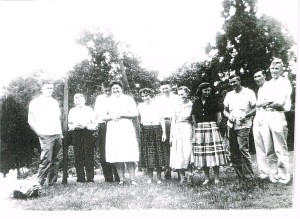
Appalachian Family transplanted to Grove City

Appalachian Family transplanted to Grove City

The same Appalachian family c. 2001 L-R Joe, Elsie, Bob, Della and Bernie Wells

The same Appalachian family c. 2001
L-R Joe, Elsie, Bob, Della and Bernie Wells

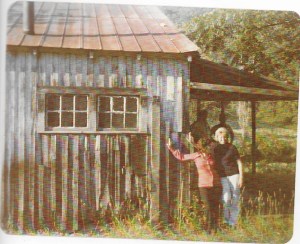
Appalachian family home KY c. 60's or 70's

Appalachian family home KY c. 60’s or 70’s

This old house was where Della and her kin lived in KY, estimated time would be 1930’s-40’s and back. This home was a three room place for a sharecropper and his family. It had a big living room, a fireplace, a big bed in the living room, the bedroom had 3 beds, there was a big kitchen and a long table with chairs made by Della’s father. Three kids slept in each bed and parents were in the living room. In order to find this home, Della and her husband had to work hard traipsing through weeds and looking out for snakes before they were able to find this and take a photo.

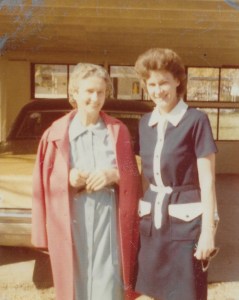
Mom (Della's mother-in-law but what we called her) and Norma Jean Welsh 1974

Mom (Della’s mother-in-law but what we called her) and Norma Jean Welsh 1974

Mom and Norma Jean are standing in front of the garage for their home and Della and Don’s home. Behind the windows is Della and Don’s home and in front of them (which you can’t see of course) is their home. It was a two car garage and attached to it is the original home that Don and Della lived in before they built the home behind the window. The original home was a one bedroom house that I vaguely remember from peering through the window from time to time. It had no bathroom and so Della, Don and the two girls had to go to Mom and Norma’s for hygiene.

Women’s History

It is very important that we look at both women and men of history. If not, we are only getting a one sided approach to the story. When I first took Women’s History it was at Santa Barbara City College in the early 90’s. The first thing our teacher had us do was to write down 10 women in history who were not celebrities or first ladies. She knew this would make our job much harder. This was very important because very few people in the class could think of 10 women. Aside from the typical names such as Clara Barton, Betsy Ross, Florence Nightingale, this was really what we knew, nurses or seamstresses. Each week, we began to learn so much more about our history, surprises that women were involved in major historical events and yet we had never heard of them.

One of the most fascinating to me was Victoria Woodhull. I want to write a little bit more about her in the future but I thought I’d get a head start here. Victoria was the first woman to ever run for President. She is from Homer,Ohio but no one has ever heard of her. Not unless they are a woman and a professor of history. What is even more important about Ms. Woodhull is that she spearheaded a campaign in front of the House Judiciary Committee. She was very convincing when she pointed out that we didn’t need to “re-invent the wheel,” so to speak because the constitution did not say women could not vote. Things were turned upside down though because the heads of the Women’s Suffrage Movement, were pretty upset with her because she had been outspoken about one of their brothers who had cheated on his wife and happened to be a minister. This bit of history gets me so upset more than anything else because it is where you see that women have big ego’s, just like men do. These women made sure to overturn the minds of the already convinced men of the House Judiciary Committee and turned Ms. Woodhull’s appearance into a joke. What is the cliché? Wagging the Dog? Ms. Woodhull was also very very much ahead of her time. She was  what we would call today a hippie mindset. Back then, it was un-mannerly, not very lady-like. She believed in free-love, was a psychic and ran a commune for some time.

It is amazing when you think about the fact that it took us almost 100 years from the beginning of the suffrage movement until the 19th Amendment was passed in 1920. Ms. Woodhull would have decreased this substantially. It is this story I like to share with women when they say that we are better at being leaders and running countries and so forth and so on. No gender is better at anything, except what they are only physically capable of doing due to their gender. You can learn more about Victoria Woodhull in the book “Notorious Victoria,” by Mary Gabriel. Lots of photos in here too as well as being a compelling read.

My question next is with all these wonderful books out there that are focused on women’s history, why is it that society, here in America only seems to know about the Suffragette Movement? The movie industry seems to re-hash the concept of women’s right to vote over and over again as if this is the only thing we have ever accomplished in this country. Actresses continue to complain about no good roles out there for older women or even younger women, though are there good roles for men? Being a movie aficionado myself, I can’t even bare to watch American movies anymore because they are so ridiculous. Either focused on a super-hero, chic flicks or just really poor writing. Meanwhile, the rest of the world has no problem featuring women, young and old, in very good storylines. Not only are they doing this, they do not have Actresses who look like a Victoria Secret model either. In fact, Actresses abroad come in all shapes and sizes, just like real people. I have often questioned why these American Actresses, who make millions of dollars aren’t spending their money making good quality films with females in the lead? Telling Women’s History would be a good place to start. We can be very shallow over here. This is why I wanted to do my part in remembering some of these ladies locally, before they are forgotten by a society who seems hell bent on focusing on modern technology and cheap labor in China.

Women worked hard, alongside men to bring us where we are today and we have ruined so much of what we fought for here in this country. At the same time our history is being ruined by the politically correct studios who are catering now to this mindset that we should alter history to make sure someone gets a part so that some group won’t be offended. This means our children are not learning the truth about the past. This is wrong because there is no integrity here. It is very sad and pathetic when we lie about the past.

There is integrity in what I write because I am not trying to spare anyone’s feelings. I am going to write a person’s story in here, based on the facts that I am aware of from the research I have done. Sometimes I will point out, like I did above, that my gender has screwed up their own history and made life miserable for themselves. This is meant to be honest, not anti-women and I also don’t want to be biased. What I would like to do on this website is feature women, past and present that I have been able to relate to and who have really inspired me to put this together in the first place. It is subtitled Transformed Women in respect to my own book that is helping women to become transformed. To become women who are able to have the life they want. A life that can be theirs when they learn to ask for what they want in a wise way vs. a bitchy/Diva way and when they learn to set boundaries for themselves in the same manner. I help teach women in my book how to do this. The women I will write about here have already done their best to make this happen and have made history as a result, whether it was good or bad. Mistakes and all because no one is perfect.

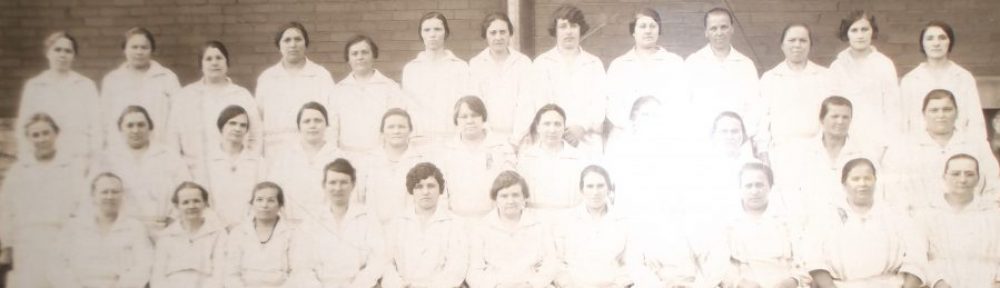
I hope you will enjoy reading some of these stories. I will also gather items off the Internet, such as YouTube videos and photos when I can find them. The cover photo for this website is a cropped version that came from the Ohio Historical Society. This is a photo of women who went to work during WWII and consequently had to go back home and become unemployed when the men came home.

If you are aware of stories of Ohio Women, please let me know about them. If you have any good books you would recommend, I’d love it if you would share this with me as well (no matter where the women came from). I am always looking for a good book to read. Thank you and welcome to my chapter of Women’s History, stories of ladies from here in my home state of Ohio.