Please enjoy a full length feature of Lillian Gish from Springfield, OH and
Theda Bara from Cincinnati, Ohio
Two women who will be featured today at the Ohio History Museum in Columbus, OH from noon-12:30.
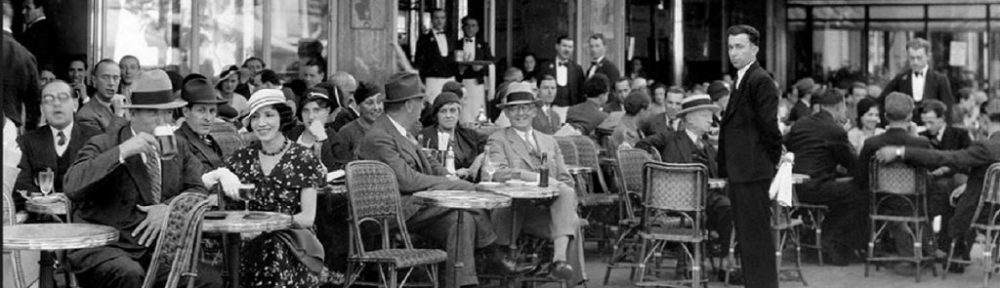
Please enjoy a full length feature of Lillian Gish from Springfield, OH and
Theda Bara from Cincinnati, Ohio
Two women who will be featured today at the Ohio History Museum in Columbus, OH from noon-12:30.
If you are like me, you have a collection of women’s history books on your shelves. My most recent find is, Ohio’s Remarkable Women, written by Greta Anderson (Columbus School for Girls Alumni) and Revised by Susan Sawyer (2015). I have several women’s history collections and now one that focuses exclusively on Ohio women or women who’s contributions were specific to or began in Ohio. Here are the ladies you will find in this book:
Frances Dana Gage – Social Reformer
Harriet Beecher Stowe – “The Little Lady Who Made a Big War”
Eliza Jane Trimble Thompson – Mother of a Crusade
Mary Ann Ball Bickerdyke – The Nurse Who Outranked General Sherman
Victoria C. Woodhull – Avatar of Free Love and the Vote
Hallie Quinn Brown – A Builder of Schools
Annie Oakley – Little Sure Shot
Helen Herron Taft – White House Bound
Lillian D. Wald – Founder of Public Health Nursing
Jane Edna Hunter – A beacon for the Black Working Woman
Florence Ellinwood Allen – A Woman of Justice
Ella P. Stewart – Trailblazing Toledoan
Lois Lenski – Collaborator with Children
Dorothy Fuldheim – Cleveland’s Media Doyenne
On the first few pages, there is a map of Ohio which shows the cities that will be mentioned in the book so you can see where some of these smaller towns are and have a sense of what part of the state they are in. This is a very small 155 page book so it doesn’t come close to all of the women from Ohio who have made history in or from our great state. My intent is to bring to life so many more valuable contributions on here. I believe this book is part of a series of other books on women from other states. The series itself are titled “More than Petticoats,” Remarkable [insert State] Women.
My favorite new story, from this collection, would have to be Dorothy Fuldheim or the best which was saved for last. Dorothy was a Jewish woman who faced Adolph Hitler, as a journalist, and before the concentration camps had begun. He was just rising to power and beginning to speak on anti-Semitism at his lectures. Dorothy, who spoke German, was in Germany and out of curiosity travelled to Munich to get a chance to interview him. She was struck by the comments made by several Germans she had met while travelling in Europe about all the jobs Hitler was going to bring for the people. Naturally she wanted to know who such a person was. She used flattery at his office, to get him to talk to her and then was taken aback, once more by what he had to say, not knowing she of course was Jewish. When she returned to Ohio, she tried explaining to people the concerns she saw in this new leader but everyone she spoke to decided she was being overly dramatic. She went on to host “The One O’Clock Club” on the radio and continued her journalistic career through several other media outlets as well. What fascinated me the most was her respect for freedom of speech. This was shown by a quote she put over her guests chair (on the radio station) which read “I may disapprove of what you say, but I will defend to the death your right to say it.” This is certainly not shared by journalists of today and it is quite sad considering it follows as our first amendment rights in the constitution. Instead we see emotionally damaging words against people who are merely standing up for what they believe in.
If you have a chance, be sure to pick up a copy of this wonderful little collection and add it to your women’s history shelves. I think you will be glad you did.
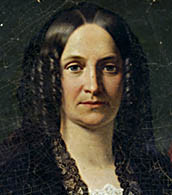 At my visit to Adena Mansions, I was told by the guide that Sarah was what we would call a feminist today, as she was a champion of women’s and children’s rights. I learned there was one book written about her In Winter We Flourish by Anna Shannon McAllister (1939), and I set about to find it and read it to learn more about this great woman. Some heralded her as an American Queen, though she only wished to be known as a queen in Heaven.
Sarah Ann (May 10, 1800- February 6, 1877; Taurus – Demeter) was the second daughter and child of Thomas Worthington, sixth governor of Ohio, also known as “The Father of Ohio,” and Eleanor Swearingen. She grew up at Adena Mansion with nine other children and a whole system of laborers to monitor the estate but who were also thought of as family. Her parents were devoted to each other and to their faith. A precocious young girl who enjoyed having fun yet she was also studious and appreciated rules and order. She was a linguist and would come to speak Italian, German and French. Her early beginnings in the arts were as an accomplished pianist who was often invited to give recitals during social gatherings. As a woman she was pious beginning her spiritual pilgrimage as an Episcopalian and later converted to Catholicism in 1855. She was a good woman, a good wife and mother and later a patron of the arts, as well as a philanthropist, in general, who not only gave to charities, began them.
Firstly, she became a wife five days after her sixteenth birthday and this was to Edward King who became an attorney and opened his own firm in Cincinnati. He was also twice the Speaker of the House of Representatives and he founded the Cincinnati law school (now known as the University of Cincinnati, College of Law). While she would have a wonderfully devoted marriage as her parents, there was great disappointment in her attempts at child bearing. She gave birth to five children but only two survived. This would be Rufus and Tom but by her death, only Rufus would remain as Tom only lived to be thirty-one.
While married to Edward, she began utilizing her time and money to help those less fortunate. This started in 1832 when she helped aid families during a flood in Cincinnati. During that same year there would be a cholera outbreak and Sarah would help nurse the sick and even opened a portion of her home to house some of the worst cases. This was a bit surprising as her husband, from all his travels, was in another part of the home suffering from malaria. In 1833 she opened the Protestant Orphan Asylum which by 1939 was located in Mount Auburn (It is assumed this is now closed, as there is only a reference to another establishment built in 1849 online).
The passionate love of 20 years would end on February 6, 1836. Sarah, being a strong woman, used her period of mourning to follow her sons to Cambridge and opened the upstairs of her home to other young boys also attending the university. After graduation from Harvard, one son, Rufus would follow in his father’s footsteps and open a law office in Cincinnati. Tom began a practice in Philadelphia and his mother remained there as she was not yet ready to return to the home of she and her late husband. Both her sons would marry within two years’ time.
Eight years after the death of her first husband, she would marry William Peters. She was now forty-four years old and he was considerably older than she. They would stay married for almost 10 years until his death in 1853. It is through this marriage though when she begins to flourish more in her contributions to women and children. She was devoted to helping women acquire skills so that they may be able to have economic independence. Her first attempt to start an organization for seamstresses failed, for unknown reasons, noted by the author in the biography. Incapable of giving in she went on to open a home for delinquent girls, Rosine Association for Magdalens (a Quaker society home), which appears to be what might be called a trade or vocational school today.
Her next project was to begin the Philadelphia School of Design in 1848. Here the women created domestic creations through textile design of wallpaper, carpets and other household needs. This was significant, not just for helping create careers for young women but because, at this time, most of these items were imported. It also gave special meaning to these women, who, at this time could not own property or have the rights to their children. This college is now known as Moore College of Art and Design and continues to be a woman only school. It is the first and only visual arts college for women in the United States. Below is an excerpt from her biography (page 142) which explains, in her words, the reason for founding this school.
Having for a number of years observed with deep concern the privation and suffering to which a large and increasing number of deserving women are exposed in this city and elsewhere for want of a wider scope in which to earn their living; and after bestowing much through and enquiry with reference to the means of alleviating their miseries, I resolved to attempt the instruction of a class of young girls in the practice of such of the arts of design as were within my reach. I selected this department of industry, not only because it presents a wide field, as yet unoccupied by our countrymen; but also because these arts can be practiced at home, without materially interfering with the routine of domestic duty, which is the peculiar province of women. Sarah Ann Worthington Peter
After tackling these projects, this is when her son Tom died. To deal with her grief she set about to sail for Europe, with his wife and children assuming her husband William would join her. This did not happen. After she returned from her trip, which lasted over a year, he would die a few months later.
Before returning to Europe the second time, she would start the Ladies Academy of Fine Arts in Cincinnati where she had now moved back to. This does not appear to still be in existence. A bust of her likeness was placed in the Cincinnati Art Museum (however a return email has not occurred to verify as to whether it is still there). Sarah would end up touring Europe six times and spent much of this time procuring art for the museums here in the U.S., meeting with several popes and other church leaders, and soon began to become a bit of celebrity whose name could be seen in various newspapers wherever she might travel. The latter aspect she did not enjoy very much. Through these travels and the delight she would take in the rites and rituals seen amongst the Catholics, as well as her conversations with these holy men, she converted to become one of the followers herself.
Toward the end of her life, she had given quite a bit of money to various convents and to the church itself. She also established some of the orders in the United States. At the age of 77 she was surrounded by her son Rufus and his wife Minnie, Sisters Martha and Antonia and a local priest. The final portion of her Eulogy found on the last page (381) of her biography and given by Reverend Edward A. Higgins, S.J., and Rector of Saint Xavier’s College was distributed as a leaflet to those amongst the funeral mass.
Nature had indeed been generous in bestowing on Mrs. Peter qualities seldom found united in the same person: a bright, keen intellect, a warm, loving heart, untiring energy, and a soul utterly devoid of selfishness. Her mother’s heart was filled with the tenderest love, the most touching solicitude, for her children and relatives. She had the kindliest and a generous relief for every form of distress. ‘God gave her largeness of heart as the sand that is on the seashore.’ All will cherish her memory, and profit by the beautiful example of her virtues. May she rest in peace. Amen.
There are many other projects and duties that Sarah took on and if you would wish to read further, I would recommend obtaining a copy of this very old book (Abe Books or at a library or other used book store). Having read the majority of this book, it is not very entertaining as it is all factual rather than story, I found her to be quite a woman. It is ladies like these that you can’t imagine ever doing anything wrong and certainly making no enemies. She walked a path of servitude that seemed to increase with age. While her father is the one who is revered in our state, women like Sarah should not be forgotten. It continues to astound me as to how little has been written about these great women. We can find so much written about royal ladies but so little about the contributions of women in history, of lesser but certainly not without means. Of course even those with little means at all, we have abandoned even more as their letters and other writings have not been set aside for posterity as would a woman’s like Sarah.
If you love history and happen to be in Ohio, or visiting, make plans to visit the Adena Mansions and tour their grounds. I believe there continues to be a couple hundred acres left so there is more than enough room to take a stroll around the property.
Long before Reese Witherspoon made the movie Wild about the adventures of Cheryl Strayed, there was Emma “Grandma” Gatewood. You can now see the full documentary, Trail Magic: The Grandma Gatewood Story as it will be coming to the Ohio History Museum on Sunday, October 16th, 2016 from 1-3pm. Emma who, at 67 years old was the first woman ever to hike the entire Appalachian Trail. A survivor of three decades of domestic violence and in the meantime raised 11 children, she finally found the courage to walk away. Inspired by an article in National Geographic, she then decided she would like to, as a woman walk the trail. Later she became a celebrity and appeared on a couple of guest spots on national television. After the film, the producers will be there to answer questions.
Also on Sunday, October 30th from 2-2:30 pm will be another interesting women’s history event. Woodhull for President! will be presented by a staff member at the Ohio History Museum.
Growing up, I was on the south side for a great majority of my childhood (1967-1980). This is because my step-father (later adopted father) was Hungarian and he took his new family to the Hungarian Reformed Church off of Woodrow Road. My parents became very active in the various groups and events surrounded and indirectly involved with the church. The ladies and the gentlemen of the church became a second family to me. When I left to live in California in 1980, over the years, they began to pass away and soon the church became what it is today, a few remaining members. I decided to write a memorial to the women specifically for their hard labor and fond memories that they created for me and hundreds of other people since the time this church was erected in 1906.
The first church organization was the Lorantffy Zsuzsanna Ladies Aid Society, which was founded in 1921 with 17 members. These ladies spoke Hungarian as their primary language and in some cases their only language. I have no connection or memories of this group at all, as I never learned to properly speak the language and my mother was not a member. Instead, I identify with these women through my father who often went to their homes after church to pay his respects (and eat!). While they were conversing in their native language, I was entertained by langos (fried bread) and 7up, which seemed to be the soda of the Magyars! Being a nosy person as well, I was also entertained by the sights and smells of their kitchens. Old Hungarian women (and German women I knew) had that distinct scent that permeated their homes since they were forever cooking.
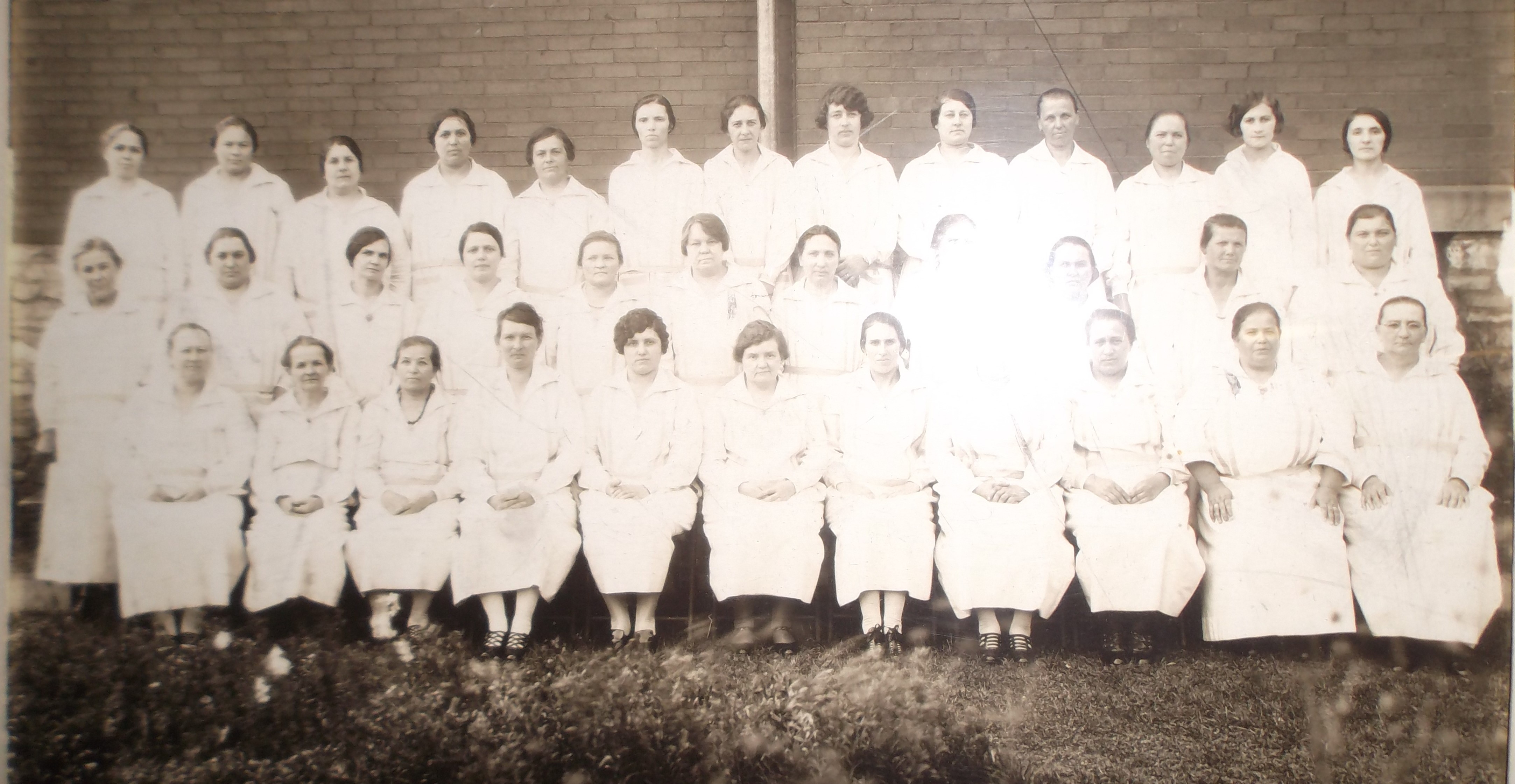
Loranttfy Zsuzsanna Ladies Aid Society c.1928
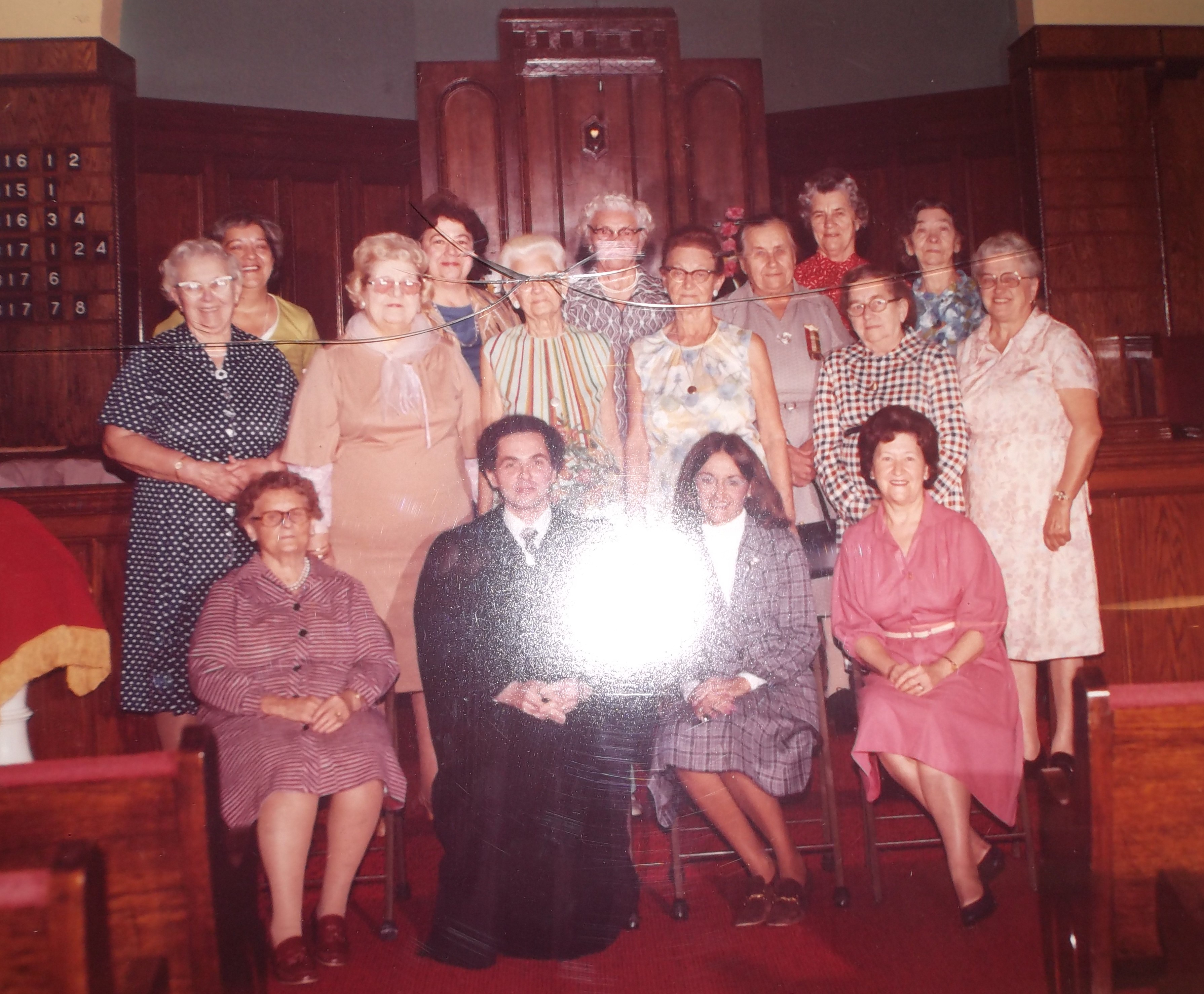
Loranttfy Zsuzsanna Ladies Aid Society c. 1981
One funny story was of a very old woman named Claraneni, whose son was often at the church. She was what you would call a hoarder in this generation, though not to the extreme as people are now. As a result, she could not allow us to leave without giving us things to take home. Hungarians are generous people and would give you the shirt off their back. She had her “trinkets” to offer. Often it was a cigar box with things she had taken home from a restaurant (i.e., plastic silverware but she seemed to also have an endless supply of wet wipes from Kentucky Fried Chicken). On one occasion, she offered my dad a pair of white men’s shoes (Pat Boone style) that her husband had once worn. We would laugh tenderly on the way home at this little old lady with such a big heart.
The Women’s Guild came together in 1940, and it was originally called the Needle and Thread Guild. This was a place for the church women to gather and be responsible for producing and directing many of the events that took place in the church. We all looked forward to the events which almost always included delicious Hungarian food. My favorite was Easter morning breakfast. While I was sitting in church, my nostrils were gently caressed by the aromas that were rising up the stairs into the sanctuary. After service as I descended the stairs, the scent became stronger and stronger. I couldn’t help salivating with impatience. My ears took in the clinking of the cutlery against the plates, from those who were quick to sit down at the tables. Standing in line for the eggs made especially for us, I couldn’t wait to be allowed to make my choice. And then finally it was my turn, and I heard “How would you like them?” I had already heard the different selections from those in front of me. This was my first time to hear the words “Sunny Side Up” and I chose this every year because it sounded like a fun choice. These bacon, eggs, and toast were well worth the wait after having to be at Sunrise service at 6:00 am. After eating breakfast of course you would be treated to jelly beans and chocolates.
The Women’s Guild also hosted the making of the kolbacs (sausages) each year, to sell, from a recipe that was made from taste not instructions. At other times they made and sold cabbage rolls and kifli’s (cookies). A cookbook entitled “Our Favorite Hungarian Recipes,” has been one of their most successful fundraisers. I am not aware of too many Hungarian women in Columbus that do not have a copy of this book. In trying to decipher the origins of this book, now in its 13th edition, the current Consistory President of the church, Ilona Isaacs, discovered that the address in her book said Columbus 7, Ohio which puts this book somewhere in between 1943 and 1963, as postal zones were instituted during World War II and zip codes replaced them on July 1, 1963. Contact the church to find out about purchasing a copy as it is still in production and under $10.00 for costs and shipping!
Another special event was the mother/daughter luncheon each May. I really treasured this time and looking back now, I know it was the value of those moments. I recall looking out across the room one year (it was a small two-story house turned into a restaurant) and seeing who had arrived, which girls went with which mothers. Some were older daughters, who didn’t attend church, so I only knew their mothers. I am a visual person and often fancied myself taking a photograph with my eyes that I swore I would never forget. While I did not forget, I wish I had a photo to show you now.
The women’s guild held an annual Big Bear luncheon to raise money for the church. One year in particular, a lady who became Bethel Nagy (I don’t recall her maiden name) arrived from Big Bear, as the caterer and left to become the future wife of our then minister. You will see the two of them side by side in both of the photos I have of the women’s groups from 1981. They are not too hard to spot in the front row.
Sometimes the younger girls, such as myself would show up for these culinary events to be put in charge of peeling potatoes or setting tables and other such duties needed for the preparation. This was always an exciting opportunity to take in the ladies in their aprons working diligently together around the huge island which housed two sinks and prep area counters in the middle, along with stoves, cabinets and more counter space on the edges of this large kitchen. They always seemed to have it together as a team. It was well organized and functioned smoothly each year. At one time, there were 56 women involved. I recently purchased an apron I found at a local antique store. When I saw it, it reminded me of the Hungarian women in the kitchen. I imagined I could still smell the scent the onions and garlic emanating from the fabric. When I tried it on, it was a little small but I didn’t care. Wearing it while I cook now gives me the most amazing sense that I am being guided by those women.
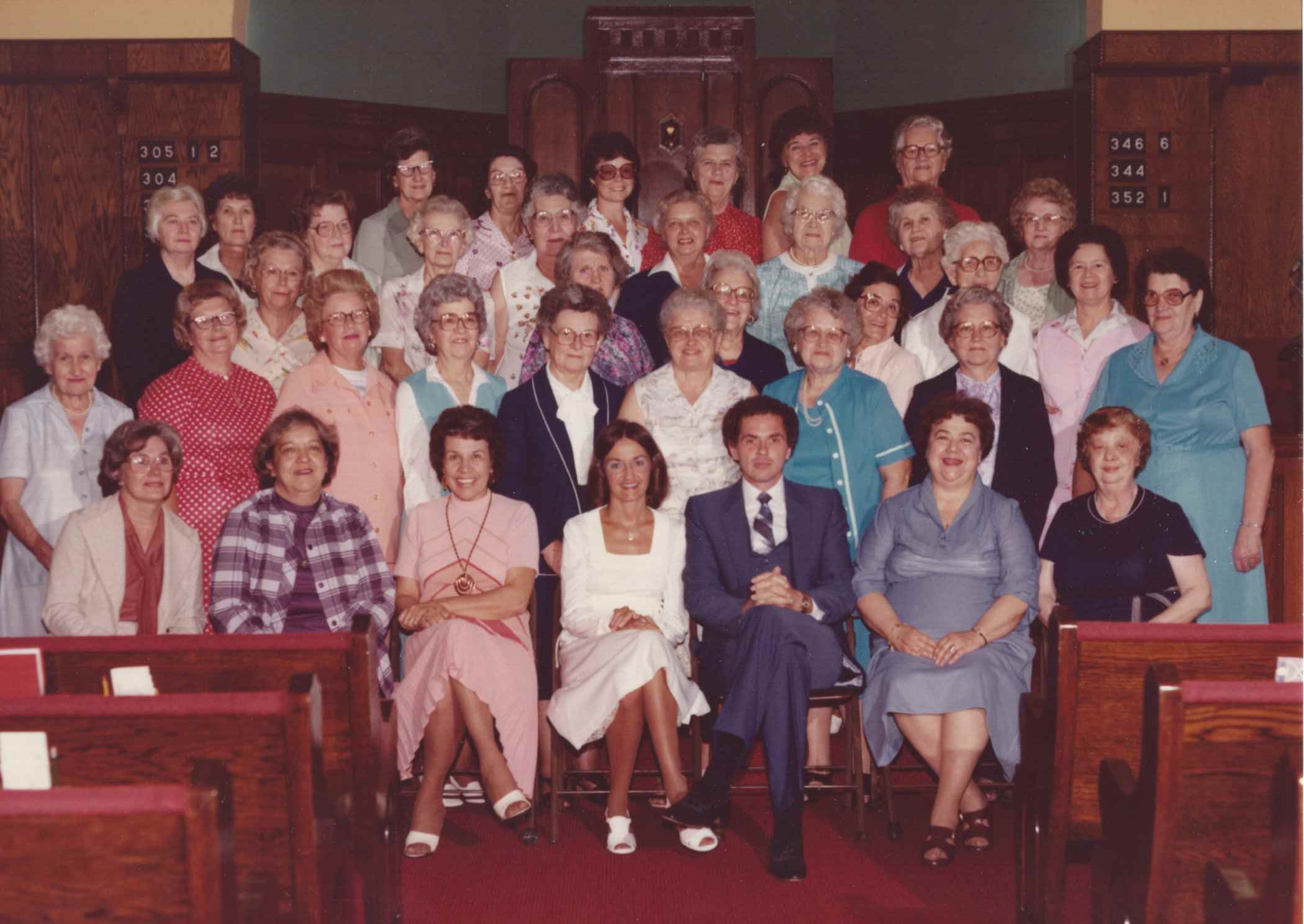
Womens Guild c. 1981
Many women were involved with the women’s guild, so I have attached a photo here from 1981. I can’t recall all of their names yet when I look at their smiles, many memories come to mind. Perhaps you might recognize your great grandma, grandma or mother. Of course this would be Edesanya, Nagymama or Anya. Please note my photos, with the exception of one of them, were taken of a photo behind glass. I tried turning some lights off to get rid of the glare. Keep in mind the photo that you see here is better than it would have been. The glass could not be removed as you will note in one photo, the last time they did, it broke.
One woman, Rose Komives, hosted her own event whenever she would go travelling around the world. I recall a couple of Asian countries, which ones I don’t remember. We would all show up downstairs in the basement, where most of our events were held and she would give us a slide presentation. Afterward she would have a display of all the beautiful items she had purchased while there. Of course her display was never absent of a few doll selections, which I admired the most. This was an interesting occasion as we didn’t get much experience with other cultures, growing up, with the exception of the United Nations festival at the Lausche building each October.
In 1976, the Mary Szanto memorial scholarship was put together on behalf of Mary who came to America in 1921 with her sister. She was very active with the Lorranttfy Zsuszanna Ladies Aid Society and the church. This scholarship has sent many Hungarian young adults to Ohio State University.
I can’t forget the two ladies who played the organ for 40 years or more. One was my own mother, Janet Vegh (now Lawton) the other was Florence Bokoros. Florence played for Hungarian and my mother played for English services. They were also on hand for weddings which they would take turns attending depending on their busy schedules. Both sang in the choir and my mother performed solo parts on holidays. She also played for a men’s quartet at one time, though this was after I had already left.
I also want to make a note of the Sunday school and our annual Vacation Bible School which were manned by the women of the church as well. Erma Pache recently died but she had taught the kindergarten ages for hundreds of children. Until her passing, if one of her former students happened to be at the church she made a point of reminding the people she was with who we were. She cherished these years as I always imagined she valued her own children and grandchildren. Vacation Bible School also included a little Hungarian lesson, when we all merged together in the basement (after our separate age groups met for class) and were having our snack. Then we would all go out to the backyard of the parsonage and play Hungarian children’s games. These were all conducted through songs that I can still manage to sing correctly after all these years.
The women of the Hungarian church were very kind and nurturing to all the children who attended. On top of all of their duties as church women, they also supported us with our school activities as well. If we sold Girl Scout cookies or chocolate bars for school and band fundraisers, you could bet you would make your quota when you showed up at the church. If you achieved some merit or got your first job, they would be delighted with your progress.
It is sad walking in the church basement and adjoining kitchen now because I am no longer greeted by at least a dozen women, in aprons, who are happy to see me and offer me a hug. These ladies were a part of a generation that once was. This generation provided us with elders that you were anxious to learn from, look up to but most of all to earn their respect. Of course your parents instilled this value which no longer appears to be present in our current society with very watered down values. It is for this reason, I have put together this website, to honor and cherish my elders, ancestors who brought all of us to where we are today. I don’t want people to forget and I hope to remind people the importance of respecting their elders.
***Special thanks to Sarah Glowa who invited me over for lunch to talk about these old memories. I also want to remember her late husband Paul who put together a wonderful 100th anniversary booklet which she allowed me to borrow. It gave me so much information about dates and the actual history of the church which I did not know. This booklet was almost finished when Paul died and before it was taken to be printed, the church made sure to make a note of his hard work and dedication in the production of its contents.
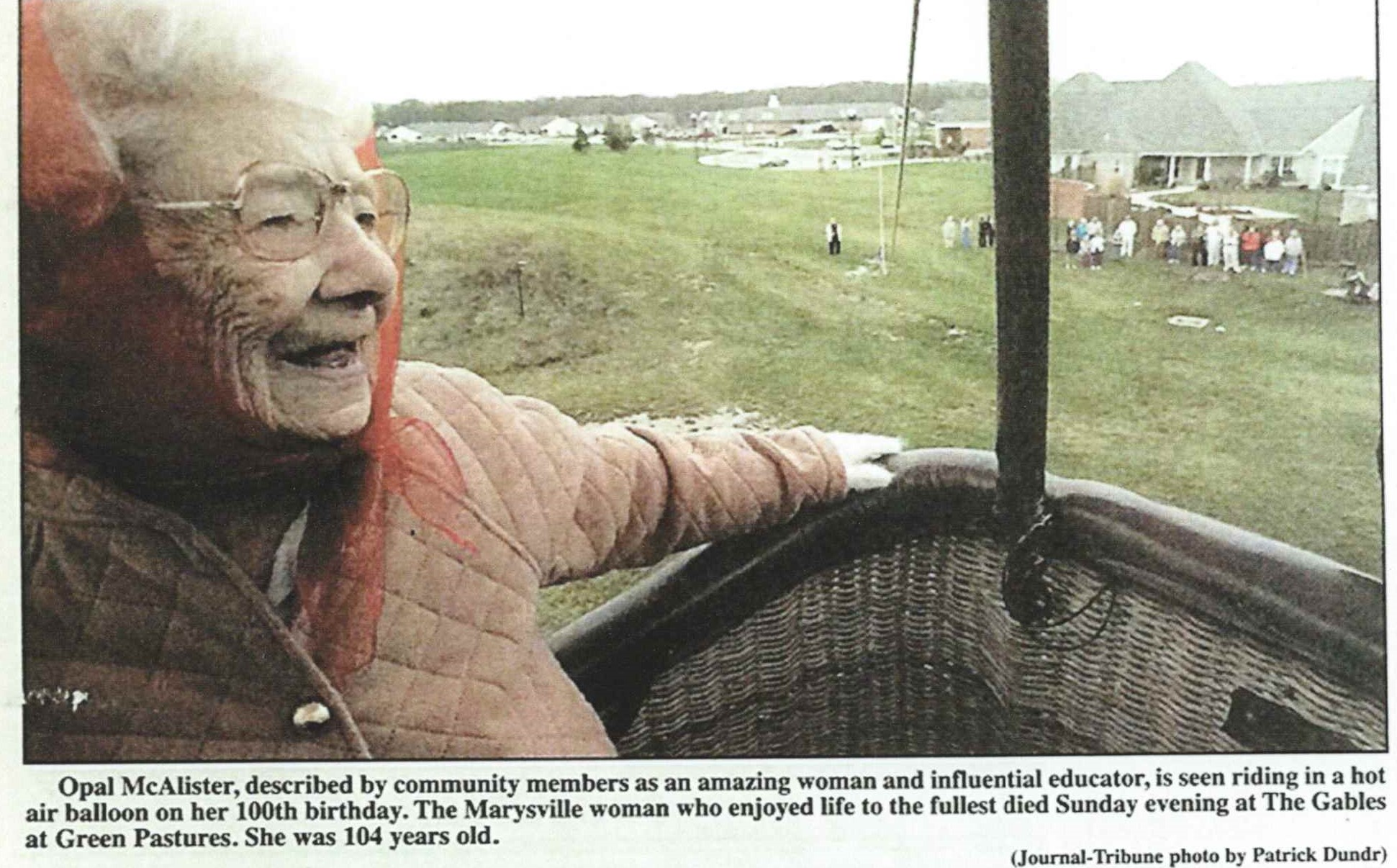 Opal Dunn McAlister – November 16, 1904 to May 10, 2009 (Scorpio and Athena Archetype).
Opal lived to be 104 years old. She was not a famous woman though after coming to learn of her history, after purchasing my home, I was intrigued by her story. She was a first woman to accomplish quite a few things in her life and so it is important to note this unsung hero (as I hope to do with other women), here on this blog.
I knew that she was the first woman to live in my home but I did not realize, until I received the Auditor’s assessment list (Franklin County) that she purchased this home as a single woman in 1930 at the age of 26! On March 3, 1930, Opal L. Dunn is listed as purchasing this home for the first time from the Minerva Realty Company. At that time, Minerva Park was not an incorporated area and had only been known as an amusement park from 1895-1902. However, in 1928, the Minerva Realty Company purchased the land and put up a few homes. Not until 1940 would the area be incorporated and officially recognized as its own community. By this time, Opal and her husband Daniel D. McAlister (married later in 1930) had moved on and another couple had moved in (1939). She and her husband lived here for 9 years, though for some reason the deed only lists Opal L. McAlister changing her name on November 9, 1936.
While researching her information I was able to find an obituary from 2009 in the Marysville Journal-Tribune. They never mentioned her early time here in Minerva Park but they mentioned so many other wonderful tributes. She was “described as an amazing woman and an influential educator,” in the article. For 52 years she worked as a teacher and principal. During her time as a teacher, she taught at Watkins Public School from 1923-26 (around Obetz Ohio) and was head coach of the Varsity Boys Basketball team. From 1927 to 1942 she began teaching in a town called Flint, which was a village that housed the Westerville Railroad station but is actually in Worthington now. I looked this up and it appears that the abandoned school is still standing on Flint Road and Park Street.
During World War II Opal had entered the Army voluntarily in 1942 at the age of 38 in Des Moines, Iowa. She was part of the Women’s Auxiliary Army Corps and earned the rank of Second Lieutenant at graduation whereby she was given the task of training women for work overseas. At the end of her career in 1946 she held the rank of Captain. In 2007 she was asked to give a speech during the dedication of the Union County Veteran’s Monument, on the courthouse lawn. She gave this presentation from memory.
After her term of service with the military, she moved back to Ohio and served as teacher at Ostrander School a town inside of Delaware County. By 1964 she had risen to the rank of first female principle of Ostrander Elementary School. She took a temporary early retirement in 1967 as her husband was very ill, returning to school after his death (1969) but not until 1970. She then remained a teacher until 1975.
She was also the president of the Delaware County Teacher’s Association for 20 years. Later she would hold a position in the Retired Teacher’s Association for the same county for 15 more years. The Journal-Tribune states that “She was honored for her teaching in Lessons of the Century: A Teaching Gem by Robert C. Johnston in Education Week magazine in September 1990.”
As you can see by the photo above, Opal celebrated her centennial by flying in a hot air balloon. When I saw this photo, it really said a lot about the former owner and first woman of many great things. I wish I had known her and would love to see some historical photos of my home and what it looked like when she actually lived here. In the meantime, I cherish owning a home that was originally purchased by a single woman, in a time when women just did not do these kinds of things.
The following article was found on the Dayton History Books Online Website. I thought the story was interesting as it talked about the work of some women in Dayton, Ohio at the end and into the beginning of the 20th century. I have edited it a little bit to clean it up.
The [original] article appeared in the Summer 1967 edition of the Montgomery County Historical Bulletin
MRS. HEDGES’ HOUSE
By Roz Young
It makes a sensitive person heartsick to see the wrecking ball of progress reduce a fine old building to rubble. Regret for what once was and cannot be again is no stranger to any of us.
But when the area known as the Haymarket was bulldozed into crushed stone and splinters and finally open land by the progress of urban renewal not long ago, nobody shed a tear or raised a protest even though many a once splendid mansion of an early day was among those reduced to wreckage.
There was a time in the last part of the previous century and the early part of this one when one of the tree-lined streets in the Haymarket was as well-known as Main Street or Third. Pearl Street ran for three blocks from 1100 East Fifth to Wayne Avenue, intersected by McLain and Howard Streets. Thirty-eight houses, most of them large, red, brick, Victorian structures, lined the street besides a cigar factory, a livery stable and the city haymarket and weigher’s office.
Most of the houses were ornately trimmed; each had the name of the proprietor, a single woman posted in the door glass or permanently etched there, and at night, in the window on a table sat a red lamp, spreading its cheery invitation to all. Within the houses many women followed a profession dignifies only by its extreme age.
Pearl Street, while admittedly the most sinful spot in town, was generally a cheery place. On warm summer evenings, strollers along the sidewalks noted that every room in the commodious houses was lighted, and from the open windows came the sprightly tinkle of player pianos and the bacchanalian shouts of the happy customers.
The houses along Pearl Street, as well as a few others in town, flourished under police control. The women who pursued their calling- there were about 150 of them altogether- had first to register with the police, be photographed and take a physical examination. No known criminals or diseased persons were permitted to work in the houses; in this the police tried to preserve the city’s reputation as being a “nice, clean town.”
Through good times and bad, the houses of the red light district kept open and prosperous. Finally, however, the religious and some civic elements in the city, after a long and wrathful campaign, forced the end of legalized prostitution. The once elegant houses fell into shabbiness, disrepair and decay until at last the bulldozers moved in. Today, not a scrap of Pearl Street remains and grass grows where once some of the most elegant men in Dayton hurried with light foot toward a favored house in which to spend an evening.
In every town in every profession, a few persons enjoy the reputation of being the best. Lawyers pridefully point to their top men; doctors defer to a handful of their finest.
On Pearl Street, the queen of all the madams was an imposing individual known as Lib Hedges. She kept a house for 39 years and in all that time, no one denied that Mrs. Hedges had the finest house, the prettiest girls, and the most genteel clients. To her pleasure palace came not only, the sporty young men of the city, but also men of maturity, judges, lawyers, city officials. They came confidently, knowing that she never talked and that their exits and entrances through the back room would forever remain a secret. And they did, too. Once when one of the girls came down with diphtheria and the health department clamped a quarantine on the house, the mayor, himself, was rumored caught there for 10 days, but which mayor he was, not even the most persistent reporter could find out now.
She was born Elizabeth Richter in Germany in 1840. The details of her early life have vanished into the mists of the swirling years. But somehow, she came to Dayton and married a no-good chap who shortly left her to make her own way in the world.
She was 36 years old, a tall, striking woman with piles of red hair on top of her head, strong features and much given to frilled shirtwaists and long, billowing skirts for daytime wear and elaborate brocades and velvet for evening. She opened a saloon on South Main Street opposite the Fairgrounds in 1876, where she sold beer in the front rooms at five cents a glass and dispensed other attractions in the back rooms at considerably higher prices.
Elizabeth had flair; her customers came again and again. She soon added to her staff, recruiting only girls from out of town, being canny enough to avoid the entanglements that local girls might bring on.
For seven years she ran the South Main Street Saloon. By then she had saved enough money to build an impressive place of red pressed brick trimmed with white carved stone at 30 Warren Street near the canal. She took a partner, too; this was her younger sister who for business purposes adopted the name of Louisa La Fontaine. Louisa was 26.
Three years after expanding into the Warren Street house, Mrs. Hedges set her sister up independently in a fine house on the corner of Howard and Pearl. A red brick, also, it had on the first floor a front and back reception room, a front and back parlor, a piano parlor, dining room and kitchen. The second floor was given over to seven bedrooms. The house was richly furnished and embellished with draperies, pictures, statuary, ornamental vases and other art objects.
Oh, how the money rolled in! Lib invested her surplus in stocks and real estate; at one time she owned over 100 pieces of property in the city. She was generous. She set a fine table for the girls and personally saw to it that each one had a bank account. If any girl decided to marry and leave her establishment, Elizabeth gave her a lovely wedding and set the couple up in one of her properties. If one died, as happened a few times, she gave her a fine funeral and a resting place in Woodland cemetery.
After one of the girls died and was buried, Mrs. Hedges decided to purchase a family plot in Woodland. She bought a corner lot on the hilltop with room for 16 graves. She then had the bodies of her parents, Herman and Elizabeth Richter, reinterred there, as well as that of the girl, whose marker reads only “Lora, 1856-1883.”
Louisa’s house was also happy and thriving. But in 1893, she fell ill, a victim of stomach cancer and after a long illness during which Elizabeth stayed with her constantly, she died May 23, 1894.
She was buried on the hilltop next to the spot Elizabeth had chosen for herself, and she erected an imposing granite shaft topped by a seated figure of a weeping goddess, done in the Greek style. It is one of the finest monuments in the cemetery.
Lib was executrix of Louisa’s estate and received all her property with the exception of one special bequest which proved to be a great embarrassment to the recipient and a source of much gossip among the townsfolk.
William, Moses, Lee and Ralph Wolf were four prosperous brothers who lived with their widowed mother Sarah on Jefferson Street not far from Warren. William and Moses operated a business under the name of Wolf Brothers, General Bill Posters and Distributors. The other two, operating as Lee Wolf and Brother, were manufacturers of cigars and dealers in tobacco and confections. They also sold books, music and operated a news depot. Both companies worked out of 100-104 South Jefferson.
Whether the Wolf brothers patronized the houses of Elizabeth and Louisa, we shall never know. All are long gone. But one of the brothers certainly made a spot for himself in Louisa’s heart somehow, for the second item of her will read:
“I give, devise, and bequeath to my friend, Moses C. Wolf, of Dayton, Ohio, the sum of one thousand dollars; also my horse and phaeton and the set of harness belonging to same…I make this bequest to my said friend as an expression of my appreciation of his uniform kindness to me.”
Of her sister, Louisa said in her will: “I give, devise and bequeath all the rest and residue of my estate, real and personal, to my beloved sister, Elizabeth Richter, formerly Elizabeth Hedges, she to have, hold, and own the same in fee simple, absolutely and forever. I make this bequest in favor of my said sister and to the exclusion of my other relatives because of the intimacy, love and affection that exists between us, and because of her kindness to me in sickness and distress.” The will was witnessed by her physician, D.M. Scheibenzuber, and John M. Sprigg, her attorney.
Shortly after Louisa’s death, Elizabeth leased her Warren Street property to Clarence Gebhart, an insurance man, and moved to the Pearl Street address.
She had an eye for business. On Sunday afternoons she went for long drives in her phaeton, accompanied by several of the girls, up one shady Dayton Street and down another. They were met with uniform cold stares by the more moral women on the avenues, but it was not their glances she was interested in. It was the husbands, she had in mind, and she got them.
On Monday evenings she closed the house to take her girls to her box at the theater, usually causing as much diversion in the audience as the show on the stage. When the city fathers organized a parade to celebrate the city centennial in 1896, Elizabeth considered for a time taking a float. But she thought better of it and probably relieved a number of worries by doing so.
She permitted no coarse language or unseemly behavior in her house. Rumor has it that the only time John L. Sullivan was knocked out was in her place. While visiting there he committed some indiscretion which Elizabeth would not abide. She indicated her displeasure, so the story goes, by hitting him over the head with a beer bottle.
Another time, so it is said, one of the local patrons, in speaking of Ollie Brown one of her girls to die in service, used a coarse word to refer to her profession. Elizabeth overheard him. Picking up a fireplace poker, she marched him into the parlor where the girls had assembled and after giving him a public lecture that would make a convert out of the roughest sinner; she threatened to spill his brains on the rug if he did not get on his knees and apologize to every girl in the room. He elected to follow her request.
One evening, the girls were entertaining their young men in the front parlor. Elizabeth was reading in the front reception room. For amusement, the girls tried to see which one could kick the highest by taking turns aiming at the chandelier. One of the girls threw herself into the project with such abandon that she made an unintentional noise.
Elizabeth, tall, costumed in floor length, plum velvet, appeared in the archway, peering into the parlor through her lorgnette.
The girls congealed in their tracks; so did the young men, their laughter dying in their throats. Her gaze slowly swept the room. “What lady,” she demanded, “done that?”
Elizabeth was generous with her contributions to charity. In 1913 Dayton was struck by the worst flood in its history. Both her houses as well as 50 other pieces of real estate she owned were in the destructive waters. To clear out the mud and filth, to replace damaged siding, foundations and furnishings, to paint, plaster and otherwise restore the buildings were herculean tasks and very expensive.
An earnest worker for the flood relief committee called on her for a subscription. “Flood relief!” Elizabeth shouted. “Why come to me? I need flood relief myself, not to be asked to donate to a subscription fund!” Then she launched into a detailed account of all the damages she had suffered.
Finally she ran out of steam. “At that, I guess I’m better off than a lot of people, the poor devils.” She fixed her sharp brown eyes on the committee member who had hoped for 500 dollars but was quite willing to take even 10. “I’ll give you something,” she growled, “but it’s not going to be much. I’ll give you two thousand dollars and not another God damned cent.”
In 1915 the police ordered all bordellos in the city to be closed. Elizabeth was outraged, as were all the other madams, but since she was ever a law-abiding citizen, she closed her place at once. The others hung on for four or five years longer, in constant trouble with the police, but finally they too, closed.
She continued to live at the Pearl Street house, but in 1918 when the city directory man came around, she told him her name was Elizabeth Richter, and from that time on she used her maiden name. In 1922, she moved back into her Warren Street home. There she continued to live surrounded by her treasures of the years, her lamps, mirrors, clocks, sewing cabinet, velvet rugs, her oak furniture, her china closets filled with Havilland, her cut glass, and her Herrick Ice Machine.
On the afternoon of April 12, 1923, the following story appeared in the newspaper:
Mrs. Elizabeth Richter
is DEAD.
The funeral will be private and will be held
Saturday morning at 9 o’clock at the residence.
Burial will be in Woodland cemetery.
The death of Mrs. Elizabeth Richter, 83, a life-
long resident of the city occurred at 8:30
Thursday morning at her residence, 30 Warren St.
She was a large holder of property and owned
stock in several Dayton corporations. Her death
followed a protracted illness.
Thus, Elizabeth Hedges finally found a quiet resting place on the hilltop along with Louisa, her parents, and three of her girls, Ollie Brown, 1843-1893, Mary Anschutz, 1877-1899, and Lora, 1856-1883.
In her will, witnessed by Roy G. Fitzgerald and William K. Marshall, she left a trust fund to the cemetery trustees to beautify and keep her family plot in good condition. She left her diamond solitaire, Louisa’s diamond locket, pictures of Louisa and her own personal belongings to a nephew along with the bulk of the estate.
Cash bequests of $1,000 each went to two other nephews and her emerald ring to Charme Wright, the daughter of her dressmaker.
She left $25,000 in war stamps, 555 shares of City Railway Company, 100 Dayton Street Railway, 24 Dayton National Bank, 140 Reliable Insurance, 300 American Rolling Mill, 100 Procter and Gamble, 100 shares Fleischmann’s Yeast and $7,000 in building and loan accounts.
She left eight vacant lots and buildings located at 16 Brown St., 13 Joe, 28-30 Warren, 610 Hickory, 1601 East Third, 101 McLain, 411-413 Montgomery, 263 Chestnut, 334-340 Sherman, 323 Troy St., 38 Horton, 612 Wayne, 623-625 Wayne, and 253 South Pearl.
The appraisers valued her estate at $202,546.17.
This is an amazing documentary of women who are called “Appalachian.” While these ladies are not from Ohio, their kinfolk migrated here over the years and settled around our fine state. You can still hear the dialect amongst certain elder women, here in Ohio and a hint of this talk from others. A wonderful lady I grew up with, used these words:
Arn – Iron
Wharsh – Wash
Davenport – Sofa or Couch
Arnge – Orange
“Well, for heaven’s sake.”
Perhaps you can recall some words that gave you a smile as well. I once worked with a client down in the Wilmington area that had such a thick dialect I often had to ask what he was saying because I had never heard his way of speaking before.
What I find superior amongst these women is their ability to be a survivor. These are ladies who would never ask for a handout from the government because they already know how to make do with what they have. If they don’t have it, they can grow it, bake it, sew it, or fix it. This is a skill that most women do not know today and could not do if their lives depended on it. I believe there will come a time when this will be necessary.
Cherish your elders while you have them. They may seem old fashioned and strange now but I guarantee you that as you age, they will make more and more sense.
Appalachian Family transplanted to Grove City

The same Appalachian family c. 2001
L-R Joe, Elsie, Bob, Della and Bernie Wells
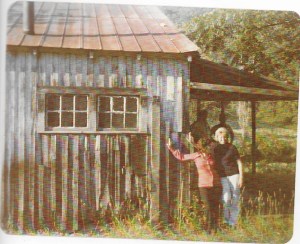
Appalachian family home KY c. 60’s or 70’s
This old house was where Della and her kin lived in KY, estimated time would be 1930’s-40’s and back. This home was a three room place for a sharecropper and his family. It had a big living room, a fireplace, a big bed in the living room, the bedroom had 3 beds, there was a big kitchen and a long table with chairs made by Della’s father. Three kids slept in each bed and parents were in the living room. In order to find this home, Della and her husband had to work hard traipsing through weeds and looking out for snakes before they were able to find this and take a photo.
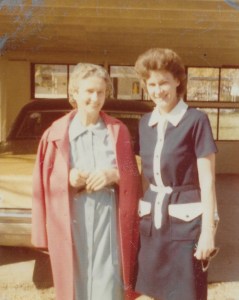
Mom (Della’s mother-in-law but what we called her) and Norma Jean Welsh 1974
Mom and Norma Jean are standing in front of the garage for their home and Della and Don’s home. Behind the windows is Della and Don’s home and in front of them (which you can’t see of course) is their home. It was a two car garage and attached to it is the original home that Don and Della lived in before they built the home behind the window. The original home was a one bedroom house that I vaguely remember from peering through the window from time to time. It had no bathroom and so Della, Don and the two girls had to go to Mom and Norma’s for hygiene.
August 13, 1860 to November 3, 1926 (Leo and either an Artemis or Athena archetype)
Where she lived is now Willowdell Ohio in Darke County, Ohio.
Essays on Politics and Life in Our America
Mental Health & Wellness
Clinical and Forensic Psychology, LLC
Discerning Gal
A Frequent Blog of Devotionals Inspired by A Course in Miracles, A Course of Love, The Way of Mastery, Choose Only Love--Plus More . . . with Celia Hales - https://www.amazon.com/author/celiahales
Freelance Novelist, Editor, Writer, and Journalist
Reading Into Our Past...
Ohio's best and biggest city
My Family Stories
Natalie. Writer. Photographer. Etc.
"Trail Magic" DVD now available
Poetry * Mythology * Podcast
Sometimes I'm just itching to write!
 Jeannine Vegh