Ohio Local History Alliance Conference 2019

Thank you to everyone who came out and supported Ohio Women’s History Project this year at the conference! If you wished to have a receipt, don’t forget to email me at ladyjatbay@gmail.com and let me know your name and how many shirts or prints that you paid for and I can send this back to you. If you still wanted to purchase a shirt, you can click on the store at the top of this page.

Ohio Local History Alliance held an amazing conference and I think we all learned a great deal from these presentations. We now have good ideas about how to take our museums, non-profits and new businesses forward in the years ahead. Below are some of the workshops I attended and information that I learned. I have included some links so that you might be able to research this more on your own.

The first workshop that I attended was given by Megan Woods, Cultural Resources
Megan Woods

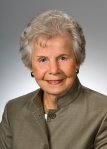
Division Director at the Ohio History Connection. Her workshop was “Ohio Women’s Suffrage Centennial.” Megan discussed how to be included on their event page on the Ohio Suffrage Centennial website. The Ohio Suffrage Centennial Commission was passed on May 2019 by Governor Mike DeWine. There is currently a travelling exhibit of banners and a trading card project going on in Northwest Ohio by the Trumbull County Historical Society.  There are also book discussion groups and you can get a list of books to read for your own groups through the Ohio League of Women Voters. In August of 2020 there will be a huge celebration that is in the planning stages at this time. Akron is working on a statue to honor Sojourner Truth. Case Western Reserve is hoping to get a play produced entitled the “Taming of the Anti.” All these and more can be found on their website above.
Harriet Taylor Upton

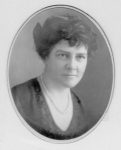
She spoke about three women in particular from Ohio, Harriett Taylor Upton who started in Ravenna and ended up in Warren. She brought the National Women’s Suffrage Association to Warren. She became the Vice Chairman of the Republican National Committee and was a part of the D.A.R. (Daughter’s of the American Revolution).

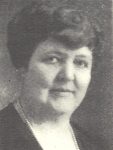
She also shared about Florence Allen who was the first female judge in Ohio but began her career first as a musician and journalist. She had left Ohio for New York to study law and then returned to eventually receive a nomination to the Ohio Supreme Court. Later she would be nominated by Franklin D. Roosevelt to the Federal Supreme Court. Florence also wrote several books about the law.
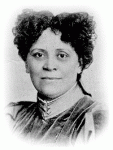
Haley Quinn Brown

The third woman was Haley Quinn Brown who was a black woman that eventually came to Wilberforce, Ohio. She was the Dean of Tuskeegee Institute, an International Public Speaker and the President of the Colored Women’s League. She was very involved in the temperance movement as well.

We listened to various people in the audience talk about their projects. One of which is that the Girl Scouts of Ohio are working on a badge to commemorate being a good citizen and learning about the voting process.

I then attended a Grant Management Basics workshop with Jennifer Souers-Chevraux who is the owner of Illumine Creative Solutions, LLC. Jennifer taught us about ways to be organized in a fashion that would help guarantee success with the grant already received. She also gave us several non-profit organizations to help with your business.

Tracy Lawson, the author of a historical book entitled “Pride of the Valley,” engaged

Savannah Homa, Tracy Lawson and Keilah Israel

with Mt. Healthy school in Springfield, to help kids become interested in their ancestry through family trees. Two young ladies came to report on their findings. These future female historians were Savannah Homa and Keilah Israel. There were a total of eight boys and girls involved in this project.

These young girls were very bright and had amazing insight into what they had discovered on this project. I was very impressed with their advanced level of thinking.

At lunch time, on Friday, we listened to Nekole Alligood from the Delaware Nation speak on re-patriating native American remains that might be found in a family member’s home. There is an organization called NAGPRA (Native American Graves Protection and Repatriation Act) which handles this type of service in a culturally appropriate way so as to bring peace to the departed. When such an event occurs it needs to be a sacred event with no press invited to the ceremony.  Nekole also made us aware of the fact that there are 44 federally recognized tribes that stem from Ohio. I wondered how many there were that were not recognized. We also learned that native American’s were not recognized or given U.S. citizenship until 1924. Even today, the issue of young women kidnapped from reservations, (which are often isolated locations with people living far from others) for purposes of human trafficking. The issue of rape was brought up many years ago in an article written for Amnesty International that I recall reading. I believe this took place in Alaska. It is interesting to note that girls are kidnapped from reservations but not outside of the reservation (i.e., non-natives). This is a huge concern because the reservations are meant to be protected lands – so why are the people on them not protected?
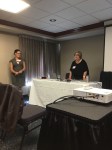
Sue Plummer and Christine Anderson

Another workshop I attended was on the “Women of King Records.” King Records was a recording studio, manufacturer and shipping warehouse run by Syd Nathan between 1943-1971, in the Cincinnati area. Christine Anderson, a professor from Xavier University in Cincinnati and Sue Plummer an Ohio History Service Corps Alumni, have been conducting research to uncover the women who produced music during that time. They shared a spreadsheet with their findings which held 2,054 recordings of various genres including hillbilly, Doo-Wop, funk and soul. They gave us access to this spreadsheet which includes links to YouTube videos if they were available. I am not sure whether or not it is acceptable to share this link so I will keep that to myself. You can however access this website which appears to be linked to Xavier University.

As you can imagined I had a wonderful time at this conference but I feel safe in saying most people seemed to be having a good time. There were smiles on these eager faces, as they walked about and the people I talked with all agreed that they enjoyed attending.

Remember #olhaempowers to follow on Instagram or Twitter.

Hungarian Americans Celebrate!

All over Ohio, we have Hungarian churches that once flourished and now are seeing a decline in membership – often closing doors (i.e., Cleveland several of them). However, the festivals, all over the state, still seem to see a rise in numbers coming out to share in their cultural identity. Here in Columbus we not only have Hungarian festivals in the summer but Italian, Irish, Greek, among the remaining European ethnicity. These festivals are put together by dedicated European/American women and men who tirelessly put in volunteer hours to share their passion with the public. This past weekend, braving 100 + degree temperatures, people flocked to St. Ladislaus Catholic Church where, once again, the Hungarian Cultural Association (HCA) put on their (50th? approximately) annual fete. It is important to keep the old ways alive through: stories, dances, folk songs, recipes, family so that the next generation won’t forget their history. Here are some photos taken by myself and Olga Kovacs both members of the HCA.


Ohio Writer Margaret Peterson Haddix

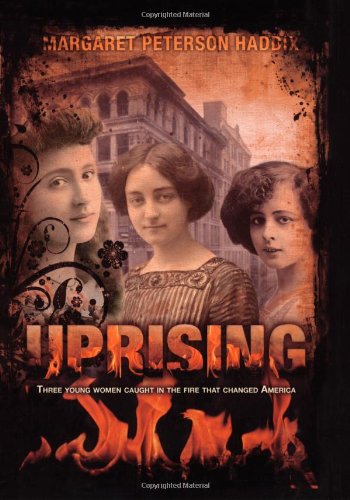
This time I am not giving you an account of an Ohio Woman in History but a female writer from Ohio who writes children’s books. I chose her book, “Uprising” which is about the Triangle Shirtwaist Fire which occurred on March 25, 1911. This tragedy occurred in New York and claimed the lives of 146 people (123 women and 23 men). The majority of the victims were between the ages of 14-23 years old. Ms. Haddix chose to do a historical fiction to discuss this terrible incident by focusing her story around three women who might have been involved. She carefully researched her book in great detail (which she tells you in an author’s note at the end).
This included a strike that occurred between the months of 1909-1910. This strike demanded many things, hoping to make working conditions fairer and safer. The union caved too quickly and did not even secure a “closed” shop which would have meant that Triangle could not hire non-union workers. Shortly after sending the strikers back to work, the “promises” quickly faded. It is odd that the union wasn’t called to the mat in court, as well as the owners of Triangle Shirtwaist Company, Max Blanck and Isaac Harris. Had the union succeeded in securing rights for the worker’s this horrible event would not have happened.

The story which unfolds is beautifully told. Ms. Haddix breaks the story up by the three girl’s names, so that we hear each of their voices. One is a Russian Jew, Yetta; then there is Bella an Italian that had recently arrived and finally there is Jane, a wealthy young American woman ripe on the heels of the suffragist’s movement. At first none of them even know each other but through various events are brought together. At the end, only one of them will survive and this is not a secret as you are told this at the beginning of the book. And, like with “The Nightingale,” by Kristen Hannah (another historical novel but about German occupied France) the ending is a surprise.

The story has romance, it is of course ripe with suspense and the characters all have self-reflection. In the end, the writer tells us how she knows what happened to the other two characters. This is Ms. Haddix’s way of answering all of the reader’s questions. The most significant is “How could she possibly know.”

Naturally, I knew about this piece of history and as it happened, it came up at least twice, prior to reading this, while I was judging National History Day. Since I had purchased the book a year prior, at Ohioana, I knew I needed to sit down and pour over the pages which were now begging to be read. While reading this book, another issue kept gnawing at me that always has since our factories were signed over to China under the Clinton regime. What a waste! For years since the trade agreement was signed and our small towns (quite a few in Ohio, including Middletown which you read about in “Hillbilly Elegy” by another Ohioan, J.D. Vance) have been turned into meth labs and are screaming for answers to bring back a dwindling economy stolen from them 20+ years ago. All the work that these men and women went through, several decades ago, to create: fair wage laws, equal employment, age limits and humane working conditions; completely lost by the stroke of a President’s hand. Now, American factories are in communist countries, third world environments that have none of these rights at hand.

When I read this book and I hope many of you will as well, I think particularly of 146 workers who died in vain. What would Yetta think if she saw that what the striker’s worked for only became a temporary fix? What has happened to unions that were there to protect the worker’s jobs? I keep wondering if the unions had caved just like they did at the end of the shirtwaist worker’s strike. Max and Isaac, the owners of Triangle Shirtwaist Company are just two CEO’s not unlike those of our big corporations today. These multimillion dollar companies, today, are no more interested in their employees or even their customers. Perhaps we have better laws now to protect employees from a fire breaking out in a building but there are just different issues at hand in this generation. As I am a therapist in my day job, I often hear employees talking about how 1. They can’t talk to Human Resources anymore because they are in another country or state (different time zones). 2. They are expected to work off the clock (or on salary) and take text messages and phone calls 24/7 in some cases. That is to say, whenever the boss has a question. Meanwhile, as a customer, when was the last time you called a corporation and actually spoke to a receptionist? Likewise, how often did you get the right person on the phone or had to call back several times. How long was it between the time you first called the company, till the time you got your answer?

Serious questions that politicians always fight about to get votes but never really solve.

Victoria Woodhull Documentary

Eden Valley Enterprises is seeking donations for their documentary on Victoria Woodhull. As you can see by this trailer, it is going to be a great success! They have already created a wonderful documentary on Emma “Grandma” Gatewood, which I got a chance to see at a screening at the Ohio History Connection. The film entitled “Trail Magic: The Grandma Gatewood Story,” was nominated for an Emmy! So you know your donations are in good hands. Both Grandma Gatewood and Victoria Woodhull’s stories are available in a storytelling program for presentations.

Senate Bill 30 – Suffrage Centennial Commission

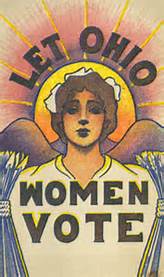
When I went to Ohio’s Statehood Day in February, I learned that they were putting together a bill for an Ohio Women’s Suffrage Centennial Commission. The good news is that it was passed on April 11th and is now awaiting Governor DeWine’s signature. This bill was sponsored by both a Republican (Stephanie Kunze – Hilliard) and a Democrat (Sandra Williams – Cleveland), which is a good thing in and of itself. I say this because it is nice to bring back some balance in politics which is how the journey for women’s suffrage began. Women from all different backgrounds came together in support of this cause. Unfortunately, there was a lot of drama between these women which caused the groups to split up into different factions as well. This would result in our suffrage taking much longer (approximately 70 years) before being ratified in 1920. Now, we have had 100 years of being able to vote in the elections and create an impact on who will serve in office.
The established date is 1848, at Seneca Falls, New York, for when women’s suffrage “began.” However, in order for them to get to New York and have this convention, there were many more years of going door to door and speaking to women locally. Women met in their homes or other local establishments that might allow them to hold a public meeting. Women’s suffrage meetings were going on all over the United States and the United Kingdom prior to Seneca Falls.

The main suffrage group established, in the United States, was (NAWSA) National American Women’s Suffrage Association. NAWSA became the League of Women Voter’s after women gained the right to vote in 1920. Alice Paul had created the National Women’s Party. Victoria Woodhull had formed the Equal Rights Party, as her short lived party when she ran for president in 1872.She also spoke to the House Judiciary Committee, a year prior to argue that women already had the right to vote (the Constitution did not say women could not). This was trumped by a lot of drama within the women’s suffrage factions that did not want Ms. Woodhull to go down in history for bringing us the right to vote. She had a lot of controversy surrounding her. One of the issues of concern was outing an affair, in her newspaper, of a highly revered minister; who was the brother of one of the top women in NAWSA.

President Woodrow Wilson is the leader who finally gave in, under duress from his wife and signed this bill once it was approved in the House and Senate. He was no more in favor of suffrage than President Lincoln originally was of ending slavery. In the end, they were swayed by a majority of their constituents and realizing it was the popular thing to do.

Thusly, a century later, our state is forming a commission to hold events and raise awareness about the importance and historical significance of the ratification of the 19th Amendment. Stay tuned to learn more!

Statehood Day 2019 – What I learned

Happy 216th Birthday Ohio! We celebrated today at the Capital Building in downtown Columbus, Ohio. Part of the building was built in 1861 and then an addition was added in the early 1900’s. I took a tour of some of the building and later went back to get a look at the museum after the Statehood Day events were over with. There is a “Ladies Gallery” room on the first floor that is not part of the museum. There isn’t much in there for the moment but a lot to learn in a short amount of time. It is mainly focused on the first six women elected to the Ohio Senate and State Representatives in 1920 when Women’s Suffrage was ratified. These women were: State Representatives -Nettie Mackenzie Clapp, Lulu Thomas Gleason, Adelaide  Sterling Ott, Mary Martin Van Wye and then State Senate – Maude Comstock Waitt and Nettie Bromley Loughead.
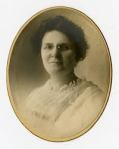
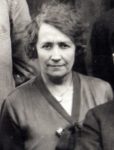
Adelaide Sterling Ott

Lulu Thomas Gleeson

Mary Martin Van Wye

Nettie MacKenzie Clapp

Maude Comstock Waitt

Nettie Bromley Loughead

Sorry the photo spread looks horrible – this is WordPress for you. Here are some of the other interesting tidbits that I learned as well today:

Jo Ann Davidson, above, was the First Woman to be the Speaker of the Ohio House of Representatives from 1995-2000.

in 2020 six women will be featured at the Delaware Country Historical Society Museum. They featured six women a year ago and they are doing this every two years it sounds like.

Prior to the 19th Amendment being ratified, Ohio had 30 Suffrage Organizations. Tennessee was the late state to ratify this Amendment. They were worried about black women having the right to vote.

Ohio has more sites on the National Historic Register than any other state (with the exception of two other states).

National History Day began in Ohio in 1974.

Kirby’s Mill in Richfield, Ohio is a popular Girl Scout retreat, as well as being used for other things.

Indian Burial grounds are ripe for poachers in Ohio and for some reason, even though the Ohio History Connection is loaded with artifacts from the native people’s who once lived here, there has never been a law passed in respect to this. There is now a request to support legislation sponsored by Gary Scherer (R-Circleville) to protect unmarked burial places and abandoned cemeteries.

Overall, the day went very well. I thought I had brought my camera home and it turns out the box was empty, so now I have to figure out where it is at my office! My intention is to go back and get lots of photos, which I will have to put on Instagram since WordPress is just not set up to properly display photos (not unless you want to read a bunch of stuff online about it and are a software designer or graphics artist which I am not).

This is my second time to attend Statehood Day and each time I find it very educational. I forgot to mention that there was a group of people in costume, who serenaded us at the beginning of the day with their rendition of Beautiful Ohio, which is a very lovely tune!


Honor the Ladies!

I felt it was important to put something together, as a memorial for women in Ohio’s history. I have been working on this for the last couple of months and then met up with a graphics artist that I was referred to. Samantha Vickers is in Cleveland and runs a company called Intentions Studio Design. We spoke on the phone and I explained how I wanted the emblem to look. I wanted something that would be formal and elegant as this was the style in our history when these women would have been around. It was important to get a design that these women would be proud of. She had it in one take and I was really surprised. You never really know if you are explaining yourself correctly until you see the finished product.

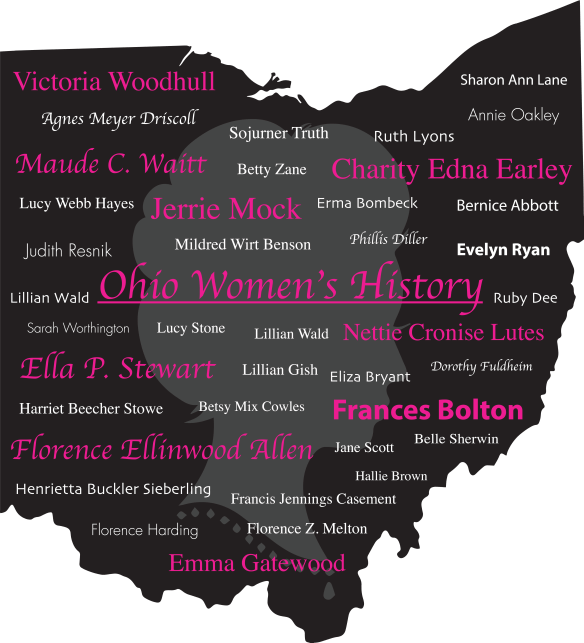
The women on this design have all passed. They are not ALL of the women in history in Ohio because you wouldn’t have been able to read the names if we did this. These are not even ALL of the women who have passed. This sample is based on women that I have written about or are preparing to do so. The names that are highlighted are women were “First” to achieve in the state of Ohio or wherever they became famous. The women that are considered for an Ohio Women’s History list are women who were either born in Ohio or those who made history here. For example, Mildred Wirt Benson (aka Carolyn Keene) was born in Ladora, Iowa and grew up there until she graduated college. When she came to Ohio, she began to write and eventually penned the “Nancy Drew Series,” or at least the majority of the stories. There are other women, like Natalie Clifford Barney who born here and lived here only 10 years. However, she went to boarding school in France and eventually stayed in Paris and ran a “Salon,” which was an intellectual gathering place for forty years. (She is not on the emblem but written about here on my blogposts).

If you click on Women’s History Store, above, you will see this emblem featured on products for men, women, youth and toddlers. This online store is based in Ohio. When you click on the products in the store, it will take you to the “EnlightenedGal” store that I created and this is through the manufacturer (CustomizedGirl). Whatever you purchase, Ohio Women’s History gets a commission from this. This is going to be set aside to pay for setting up Ohio Women’s History Project. This will be a non-profit geared toward educating and bringing awareness to our young people but also to adults. I have already given a lecture for the Westerville Kiwanis on four of the women in Ohio’s History. I would like to have contests for students, that we can feature here on the blog and will be an assignment for their history classes (If you are a teacher, please get in contact with me at ladyjatbay @ gmail.com to discuss). My way of educating will be focused on writing and lectures. The direction of this business will be based on what funds are able to be collected from the sales of these shirts in the store here.

Thank you for taking the time to peruse Ohiowomenshistory.com. Feel free to contact me about contributing an article or telling me a story about an Ohio Women in your history. They don’t need to be famous, just a remarkable person who transformed the people around her.

Jeannine Vegh, Founder of Ohio Women’s History Project