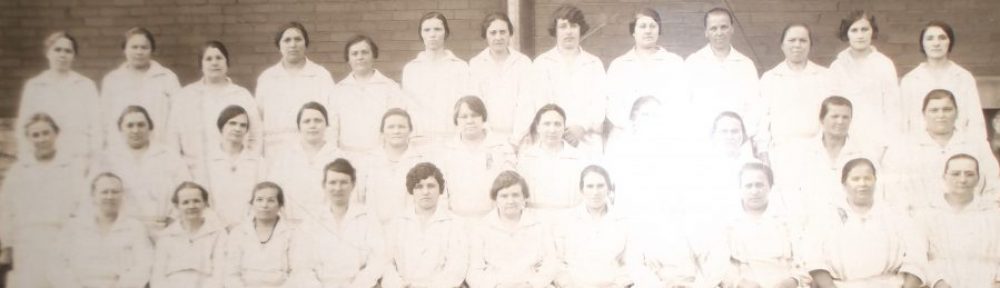
This 10 season WWII Danish period piece ran from 2013-2024 and is quite addicting to watch. You will find it on PBS. I found it to be Denmark’s description of WWII, similar to A French Village, in that they are capturing a small community of people during this period of crisis. The differences are vast, in that A French Village shows more violence and causes more stress to the viewer. In fact, at the end of A French Village, I felt emotionally exhausted. But, the French period piece is doing a lot of “Show Don’t Tell,” vs. the Danish piece is “Telling but not Showing.” Which is fine and a unique way of narrating a horrible time in history. With Seaside Hotel, we are seeing amazing actors, never out of character, who are capable of telling the story of WWII and how it impacted them. These are middle to well to do characters who choose to consistently take room and board at this seaside hotel, during the summer season. It is strangely comforting, as if your grandparents or great grandparents are talking to you from beyond the grave.
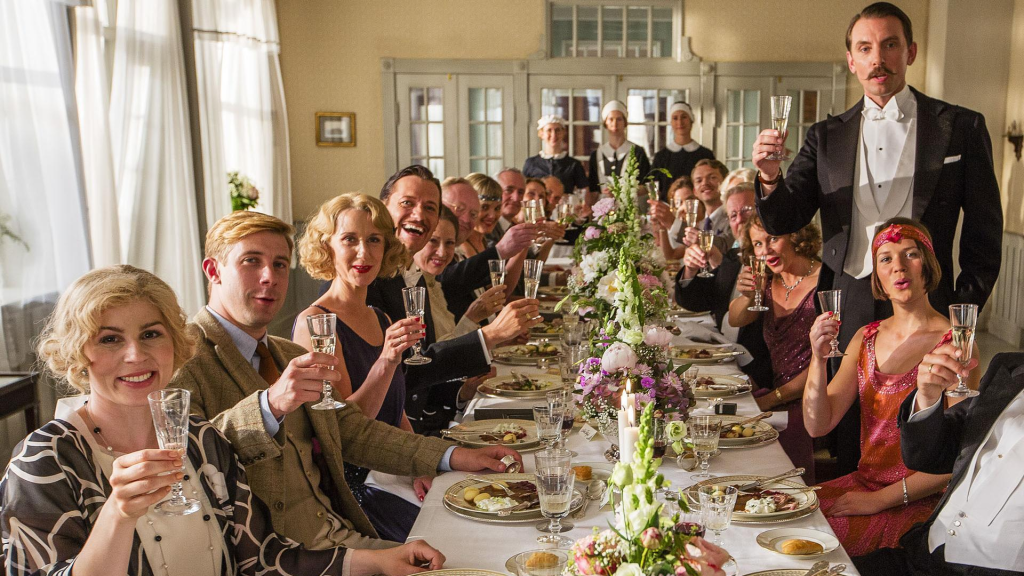
A French Village begins the day that Germany occupies France, and we begin to meet the characters of the little community. Seaside Hotel starts before this in the 1920’s, as you can see by the costumes in the photo above. The character Hjalmar Aurland, an older man married to Helene (until mid-way thru the Seasons), a much younger and very beautiful woman, narrates the story as it is being acted out. He is the voice of reason. While the others are enjoying their holiday summers, he listens to his radio (which he lugged over to the hotel) whilst ignoring his beautiful wife Helene, a very co-dependent person. He is telling the characters what he is hearing on the news, thereby explaining to us. Thus this TV series is an intellectual piece that bares paying a lot of attention to.
Everyone is self-absorbed and it is entertaining to watch. You might say all the men are narcissists, though this was normal in these roles for men and women at that time. It was easy to understand how they could avoid the war, much like Scarlett in Gone with the Wind, until it was right on top of her. As Germany steps in to the neighborhood of the Seaside Hotel, the businessmen jump into action, at the hotel and the rest take it in their own strides dependent on their personalities.
You have Edward Weyse, who has the most amazing amount of energy. He jumps into each scene, sometimes quite literally as he prances around the hotel, inside and out, doing whatever he wants, whenever he wants, no matter what others may think. This includes playing evening songs, sung in English, that no one understands, while ladies are trying to quietly play bridge and the men are engaged in conversation. He is a handsome actor who enjoys being the center of attention and cannot grasp that others are not in awe of him.
There are a lot of sex scenes, both gay and straight, though nothing graphic and mostly harmless and fun. Mr. and Mrs. Madsen have quite a passionate relationship, when he feels like it and to use for self-soothing in between business deals. They are definitely a horny couple and she uses this in order to get his attention quite well. The gay couple comes in a very realistic way and naturally you are quite certain what will happen. However, other than a couple of men dying for non-WWII reasons, no one is lost due to the fact that they need to explain what a concentration camp is and to show us how it impacted them. This is brilliant. At first I thought it was odd though, until I realized why this is happening.
There is a German/Danish love affair as well and I love how they put this couple together. Unlike the barbaric sado-masochistic relationship between Heinrich and Hortense in A French Village, the coupling of Amanda and Uwe has more softer tones and he ends up being anti-Nazi for rebellious reasons and no doubt for love. While you have a love/hate relationship for Heinrich and Hortense, you are enchanted by Amanda and Uwe.
In A French Village the season ends by telling us the end to all of what’s left of the original characters, post-WWII. They end Seaside Hotel by coming full circle in the advent of progress post WWII. In Season 1, the hotel is getting electricity for the first time, by the money grubbing or extremely anal Mr. Anderson. At the end, Valter (Edith’s husband) is beginning to explain how he sees a future with the hotel and might modernize it. This leaves us in a crisis as we have just breathed a sigh of relief that the Americans – 4-story hotel plans were disrupted once Edith and Valter buy them out.
The women in this storyline are the back story of the hotel. They are women behind the men and sometimes the women front and center. Mrs. Frigh takes over her husband’s tobacco business, almost in a coup after he dies of a heart attack. Mrs. Weyse (originally Mrs. Aurland) becomes an agony column writer, enlisting Mrs. Frigh and Mrs. Madsen for her assistants, since she is so co-dependent on others. She explains imposter syndrome indirectly through this role. Mrs. Anderson takes over the hotel, sells it to Fie, then to Amanda (her mother temporarily), then to Edith eventually, so it stays in a woman’s hands all throughout. Meanwhile, the men in the series are all somewhat horrible businessmen in many respects if it weren’t for their passive/aggressive moves, directed by their wives, which they claim to be their own. The actor Edward Weyse actually re-directs an Henrik Ibsen play (basically making fun of the TV series in a term of endearment), based on a talk with Mr. Aurland who he is inspired by (but naturally gives no credit to).
The maids and the cooks are a delight to be a part of in their “downstairs” roles. Martha reminded me of a German girl I grew up with called Inge. They were the spitting image so it was hilarious as I continued to think of the person I knew as I watched this. I didn’t like the storyline of the last two girls who became maids, as I thought this was milking the gay saga way too much. It didn’t become annoying though and it ended in a realistic way weaving her in with Dupont and Ditmar. The on-going agony between Edith and Otilia was as amusing to watch and helped to carry on many storylines, for the cooks and other maids as well as the audience.
The scenery, the hotel, it is all a stage. I was so caught up in the characters that it took a few seasons before I began to notice what was happening with the curtains and as they looked out the window. I imagine this was all on a set in a studio and then the characters had to be transported to the sea to do the outdoor shots. No matter, it is lovely and brings back so many fond memories of a time period that once was. The food was to die for! I don’t know what it was, but whomever they hired to layout these scenes with tempting gastronomic delights (except the fish scenes – yuccch!), I think I salivated over the desserts. Quite a view!
I came back to this article to insert a bit about the doors in the hotel. I think the director/cameramen did an excellent job in visually taking us from one room to another. You start in one room, listening to the end of one conversation and a character goes out the door, or comes in the door and suddenly you are in a completely different room. There are only 12 rooms to rent, eventually in this hotel, so quite a fascinating way to tell the story. I have seen this before in other movies, though this seems like an homage to Jacques Tati in M. Hulot’s Holiday, with the sound effects of the dining room door and those coming and going. While you do not hear anything necessarily, you can almost imagine it.
As I mentioned, the last season is wrapping up the hotel story there by the sea in a Danish village. It isn’t until the last moment when Mr. Weyse sings into the camera that they are slowly taking you out of the hotel. We see the two businessmen Mr. Madsen and the American guy, who has returned newly divorced, about to make yet another deal. You realize the future and how their lives will continue. As you think of the widow Mrs. Fjeldso, actually allowing herself a birthday party, maybe her last, you are comforted by the fact that the war is over, Denmark is embarking on a new era and all will be well for these lovely people.
Both TV series that I mentioned here, were probably the best ways for an American to learn about what really happened in WWII through the eyes of the French and the Danes. If you love history, as I do, you will be delighted to be entertained by both of these period pieces. Both are nationalistic and authentic, so no random politically correct characters who have no place whatsoever in this era show up. It is easy to sit back and feel that you are transported to another time and place.
 Jeannine Vegh