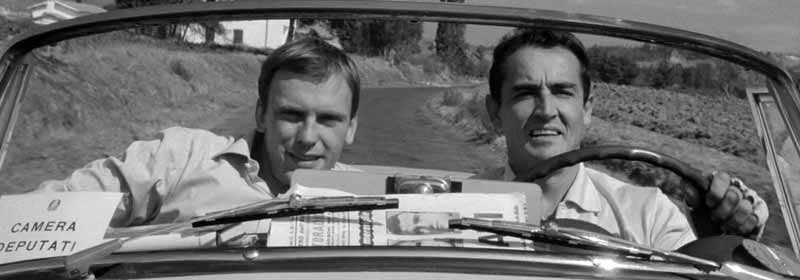
This movie came out the year I was born. It is a road movie or a coming of age film for two young men. Bruno (Vittorio Gassman – Italian) is an aging player, and Roberto (Jean-Louis Trintignant – French) a very down to earth college boy, studying law. Roberto is eager to remain the man that he is, but soon finds himself questioning life. He seems to have a love/hate relationship with Bruno, who he knows is not a good person deep down inside. Bruno, for whatever reason is escaping reality. We don’t really know his back story, though we know that he jumped into marriage with a beautiful woman and left her and their daughter to continuing roaming through life. At the end, both of these men’s lives will be turned upside down and Bruno himself will finally begin to question the life he has chosen.
The first time I saw this film, it was interesting and exciting all the same time. I had no idea where this film would go, but as I am a huge fan of Jean-Louis Trintignant, this was my reason for viewing. He was a huge French film star at this time having starred alongside Brigitte Bardot in , “And God Created Woman.” And while he worked and starred in several Italian films, he was dubbed in, which is odd as it sounds like his voice. Naturally, my favorite film that he stars in is Un homme et une femme which has the incredibly catchy film lyrics that are hard to get out of your head. They ended up making a part two of this film and later there was a “part three” which I still haven’t seen but it looks more like a documentary of the couple talking about making the film.
The second time I saw this film, a week ago, I was watching it specifically for my movie group, as I had chosen it for our discussion. Now I was also watching it with my boyfriend, so I was suddenly concerned with the annoying car horn. Bruno can’t seem to stop blowing it whenever and wherever he wants, just to announce his presence. It also seems to be clear that he knows he is annoying people, which he seems desperate to do. This aging person is in his late thirties, for a woman, our time would have been up by now but for a man, the bachelor life is one that can be forever. Though it is clear that other men are not in awe of him. Instead, most are tired of his aging, borrowing, stealing women behaviors. I think the only time men admire the bachelor is when he is a Playboy, who is wealthy and can do whatever he wants. The guy who is constantly borrowing and taking advantage of is one that no one wants around. Bruno seems to get this, but at the same time doesn’t care. He is emotionally immature. I want to put him in the role of narcissist, but in the end, he has compassion and it is clear he is deeply remorseful. Even when you listen to him talk about his daughter, he is moved that she actually cares about him.
We meet both sides of their families. First, we get to know Roberto’s aunt and uncle, whom Bruno has great fun in playing with and endearing them to his side. It is hear that Roberto grows up after seeing how things are different than he once imagined as a little boy. He is self-aware and yet still very loyal and respectful to the people he grew up with. He is shocked, at the same time, to see how Bruno is perceived and loved so quickly. Bruno can get away with things whereas Roberto is still treated with a strong hand. It is here, as he sees his family take to Bruno that Roberto begins to wonder what is he not getting. Maybe there is something about Bruno he doesn’t understand and should.
Then we meet Bruno’s wife (he never divorced her, but lied to her and made her believe he did). She gave him $600,000 Lire (which would have been $10,000 in 2025) and instead of taking it to the church for the annulment, he spent it. He and money are not good friends. What I respected about Gianna, his wife, she had good boundaries with him even though she cared and looked out for him nonetheless. His daughter Lilli comes on the scene, with her aging boyfriend Bibi. It is clearly a daddy issues relationship. He is not unlike Bruno, with the exception that it is clear he is more responsible financially. While Bruno and Roberto only spent a day with Roberto’s family, they spend the night (in a sense) and take a boat ride the next day with Gianna, Lilli and friends.
Upon leaving Bruno’s group of people, he and Roberto set out on the road once more. By this time, Roberto is no longer resistant but seems to embrace La Dolce Vita. No longer thinking about getting back to his studies, he is out to have fun. He is now trying to be like Bruno and just be a silly, crazy guy. However, what, at first seems to be fun and freeing to Roberto begins to take on a sense of reality as he somatically shows us that maybe this is not the way to behave in life. There is a moment in the film, which I want you to see for yourself that forces him to wake-up. And when he does…
This film is chosen now by the Italian Ministry of Cultural Heritage as one of the 100 films to be “saved.” These films changed the way people thought between 1942 and 1978. Which is the time period of WWII and the aftermath. Bruno is symbolic of the boy who returned and wanted to forget the past, whereas Roberto is symbolic of the boy who wanted things to stay the same. A nostalgic young man who clings to the family history. In the end, we are taught that things can’t stay the same but life also can not be wasted either. There needs to be a happy medium in life. Balance as the transition went from war survivors to a new modern life.
Jacques Tati also tried to look at the juxtaposition of life during and post WWII (with the scenery) in his film Mon Oncle. The uncle is Bruno with a little bit of money, to indulge on the wife and family, being sure to buy all the frivolities that modern technology has to offer. He is Roberto in that he is very conservative and careful with the objects that he owns and takes great pride in this fact. Jacques Tati makes fun of the uncle in his movie, but at the end, he also brings him down to earth when he shows the uncle and his son having a regressive moment together, playing like little boys.
 Jeannine Vegh