
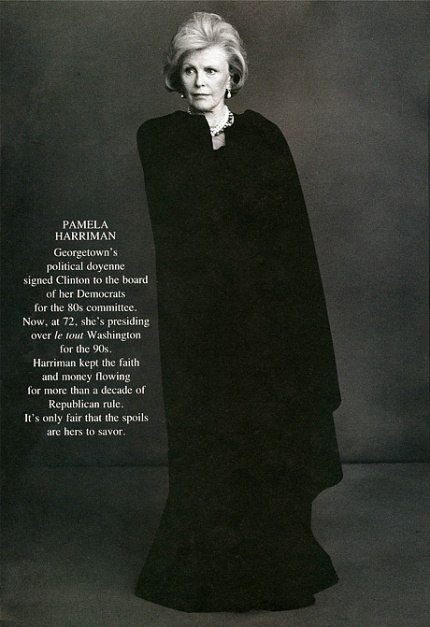
On February 5th 1997, almost seven months before the day of Princess Diana’s fatal crash, both coming from the Hotel Ritz in Paris, Pamela Harriman died suffering a heart attack while doing her favorite sport – swimming. Ironically, Henri Paul tried to save Pamela, after she was pulled from the waters and as a result of this heroic deed would become the final driver to Princess Diana.
Photo above by Annie Leibovitz
“What she really wanted–and what those men were unable to give her–was a life on her own terms. A woman born in the early twentieth century to parents who wanted a boy, who was raised only for marriage, who never had the chance of a formal education or proper career, that meant changing her name and her nationality, wrecking her health with work and worry, and waiting five decades for her second break.” Sonia Purnell, Kingmaker.
I found this book riveting from beginning to end. It reads somewhat like a novel, you almost forget the only dialogue is in quotes. What drew me in is that the story was about one woman, who was a secret spy, unknown until this book gathered the evidence to piece this together. She was not assassinated like the Mata Hari, because she was more sophisticated, sly, and had a lot of class. She did not brag about her position behind the scenes and it is amazing that she started at the age of about 19 years old and grew wiser and stronger, as a woman from her work during WWII. Work she was not “paid” for in a traditional salary.
She was seen as a home wrecker and a slut, though these performances really only occurred during the second war and on behalf of Winston Churchill. She was a liaison between her father-in-law and the Americans. It would seem that she played a strategic role in bringing the U.S. into Europe. Some were on the black market, some in the underground, some as nurses or helpers in some way. Pamela held lavish parties and wore beautiful gowns, she spoke to the heads of the military from America and would relay these messages back to Prime Minister Churchill and his words back to them.
When the war ends, you feel a sense of sadness for Pamela as her world has now come to an end. She is no longer worthy, there is no job to go to and she is all alone in the world save for her son and sums of money paid to her by lovers keeping her lifestyle afloat. Most women had the same fate post WWII. This is well documented, but you can place “Rosie the Riverters,” going back to their husbands after having worked, had a sense of independence and become strong independent women. Some women did not have husbands. During college, I had the pleasure of staying at “Stella Maris” in Los Angeles which was built and organized (by the Catholic Church – St. Michael’s I believe – down the street) to house displaced women from WWII. By the time I appeared there, it was a local college dorm for several colleges.
She married Winston Churchill’s son on a whim. Friends and family begged her to stay away, but as all young girls will do, they listen to themselves and learn from experience. Randolph was an abusive, alcoholic, womanizer, though both of his children, one from Pamela would come from a marriage. This is always what intrigues me most about women in history. How did she have all these affairs without getting pregnant – at a time before birth control was anything more than a raincoat. How did Randolph? The author sheds some vague light on this but obviously there would be no recordings or something mentioned in a diary.
Her son was born during “the Blitz” at the Prime Minister’s country residence, Chequers. Evidently it practically came with a big arrow for the German’s saying “here is where Winston might be.” Luckily for her, no one noticed that day. Though, they probably assumed they wouldn’t be there anyway. Hearing her early beginnings to her death, it is quite easy to become a cheerleader for this amazing woman. Yet, at the same time, you realize the fate that will be her challenge for most of her life. Women just didn’t do these things. They got married to wealthy men – if they came from a royal lineage and a Prime Minister’s son.
After finally annulling her short lived marriage to Randolph, she married none other than Leland Hayward – the one who purchased “The Sound of Music,” for the initial stage production. My last book to honor here on this website was “Maria” by Maria von Trapp, who received $9K from a German film company and never a penny more. Leland came with selfish children who benefitted from his money and hated the intrusion of their stepmother, whom he loved very much. He died after 11 years of marriage and then she became re-acquainted with politician Averell Harriman.
Averell and Pamela had a love affair during WWII and was one of his benefactors for some time. He could not divorce his wife, for religious reasons and so she had to wait and wait and wait. In 1971, it would become their destiny, to finally become man and wife as both were now widows. This marriage lasted until 1986. This marriage, however, seemed to jump start her career as a politician herself.
Pamela began “PamPac,” a nickname given to the Democratic Party where she was again hosting parties to raise money for them. She was pivotal in bringing various nominees into her salon and introducing them to those valuable donors. This work was key to bringing President Clinton to light and to the White House and she was rewarded with her ambassadorship to France during this time. She was in office while at the Hotel Ritz for her daily (and final) swimming jaunt.
I can never think badly about women who had to rise to the top in ways that were not necessarily appropriate for that time. The oldest profession known to women is prostitution. Certainly, Pamela could have made different choices but what would have happened differently if she had? Our life is determined by our choices and the world around us is impacted by the choices we make.
Was she a wonderful mother – no. However, she did her best to make sure her son was well taken care of, for the rest of his life. This included his first wife and children. She may not have doted on him as you might see in a Marie Cassatt painting, but she did not forget about him either. How many wealthy children are raised by nannies? Do we fault these wealthy families for paying for them? She probably wasn’t a great stepmother either, though I can’t really feel sympathy for someone living off their parents money – as an adult. Her son was one of them but at least he understood and respected where the money came from (it seems). The others wallowed in pity and Leland Hayward’s daughter not only married another Pamela hater, but wrote a book about her hatred for her stepmother. Cue the violins.
I related to Pamela in so many ways and of course found it quite humorous her early connection to Lady Di. In the book, Sonia Purnell speaks of a moment when they are at a party together and Pamela stands next to her, right when the photographers walk up. They don’t appear to have any other connection then this and their demise (unless I forgot about something). I can tell you exactly where I was standing when I heard about the fatal car crash, though I had no idea who Pamela Harriman was that year. Unless you ran in wealthy or political circles, neither would you I am sure.
We are grateful to have women’s history writers such as Sonia Purnell (who also wrote about Pamela’s first mother-in-law, Clementine), who have a passion for giving us entertaining biographies that we will never forget.
Some final words from President Clinton at her Eulogy, thanking her for her service (as noted in the book).
“Today I am here in no small measure because she was there.”
 Jeannine Vegh