A 2000 film by Wong Kar-Wai, this is a brilliantly directed, choreographed, acted, film with amazing camera work that will have you wondering what is going on. I say the latter because you will want to watch this at least two times to understand what is going on. This was the consensus of my movie group last night. I loved it the first time I watched it, but was confused, as an American, by the names, the characters and all the cameo type scenes. I loved it once I figured out what was going on the first time, and then the second time, being prepared for what was about to take place, I could relax and prepare and enjoy. I have learned with foreign films – trust the director – he knows what he is doing.
The film is made with scenes through the eyes of a camera, very small, very restricted to only the people in that scene. This is not about scenery, and yet it is, at times. The film even feels claustrophobic, so that you can take in what it must be like to live in a Chinese lifestyle. I could not enjoy this as an American and yet, due to the intimacy of the living arrangements I could almost take in the scents which I knew I would not like. Having spoken to Americans who have lived in China, Japan and other Asian countries, they shared that the scent is a bit strong for an American nose. Not quite the same as Wong Foo Young’s local Chinese restaurant, filled with fortune cookies, egg rolls and broccoli with rice in a box that we are so used to. I can imagine this having lived next door to Indian people, in Fremont, CA. The air is permeated such that your nostrils are forced to walk through a confusing, unnatural, odor that one day, you might get used to.
The claustrophobic scenes however, are similar to watching a silent film with a group of people and then listen to the sound of their voices when the film is over. I very much appreciated the scene with the palm tree near the end and the Buddhist monastery which concludes our film. By the time I saw both of these scenes, I felt I could breathe again. While I say this, there are some other scenes which are very artistic and in slow motion. I rather enjoyed watching the couple walking up/down the stairs with really lovely music in the background. I loved the hallways, and street scenes, even when they looked too clean and I knew they were not (in real life). The curtains billowing, whilst the person walked beside them, not quite touching their leg. This is similar to the actors who didn’t quite…
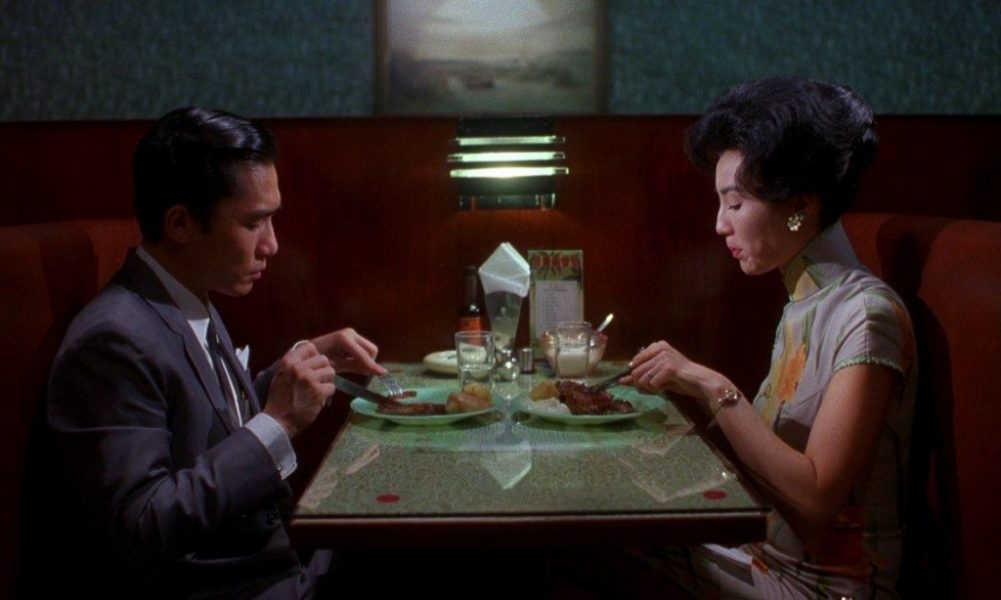
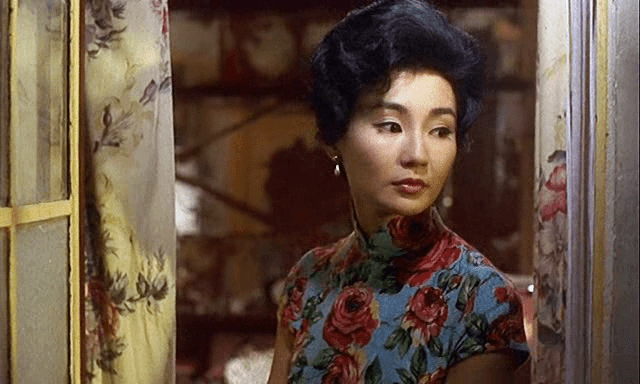
The dress that Mrs. Chan wears and there are 22 costumes, I believe, that she wears in this film (one several times) is a traditional Chinese dress called qipao (prn. key-pow). Where were they stored in that tiny apartment? While she wears it daily, with a special too high neckline, designed to accentuate her already uniquely Amazonian stature, this is not a typical daily dress from what I am told. It is used more as formal dress for the Opera, an elegant restaurant, or some other dressy affair. Yet, in this film, it is worn to the office, to a diner, and to any other occasion. On top of this, she also had her hair coiffed in a bouffant style of the 60’s, that my mother and her friends only used for the same elegant affairs and not for the office.
Again, I believe this was used to call attention to the largess of her giraffe body type. A gentleman in my movie group mentioned that he had read online that the neckline was purposely created for her to show how she was trapped in her marriage and life. This gave the feeling of her restrictions even more, though I kept thinking of giraffe’s and how she looked too tall for an Asian physique. Nonetheless, I adored her dresses, I thought the actress to be exceptionally beautiful, a Chinese Catherine Deneuve and her body language was exquisite. Identical to models of yesteryear and most women of that time period. The shoes and dress styles, and what was underneath, dictated how one would compose themselves.
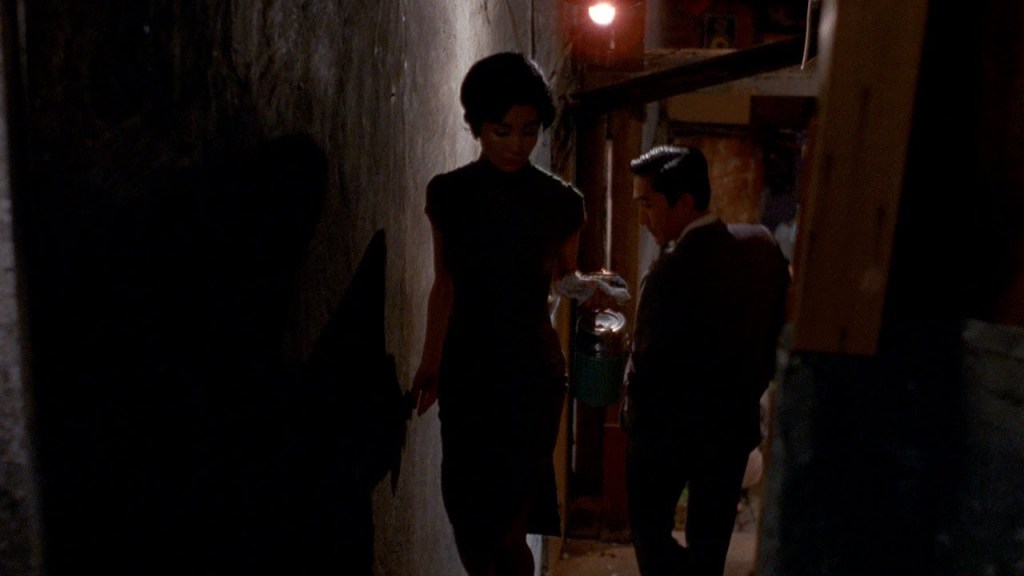
My feelings of this movie are that it would be lovely to watch in an art museum, even without subtitles. I could imagine walking in the room and seeing the scenes, listening to the music (not Chinese oddly enough), and still having a sense of what was going on. It is romantic, to say the least. This is not a typical boy meets girl, loses, girl, gets girl American rom-com. This is a well played out story of two lovers who never touch, other than in a quick but slow gesture that seems naïvely or fearfully played out. I am told there are deleted scenes, which I would prefer not to watch, as I love it as is. Having watched a great many non-Bollywood Indian films, I prefer the anticipation, the build-up, the romance to leave to your imagination. I don’t want to see sex, especially when it is not a “sex” film. I think most women know that the emotional intimacy of a relationship is much more memorable than a graphic scene designed to make the couple look dirty or play to the audiences voyeuristic whims.
The ending is a great foreign ending, leave them hanging. Give them something to talk about in a movie group. This is a son that you are left wondering “Who is this?” There is a speaking into a hole – a Buddhist custom of telling your secrets, mentioned previously in the movie. There is no “Everyone lives happily ever after.” This is not reality. It is not how life works. I love the ending because it is the beginning. Both are living a new life. Both are going in two different directions. Will they ever meet again? Will Scarlett and Rhett ever get back together. It is an ending that we don’t need to know. Do you know the ending to your life?

 Jeannine Vegh