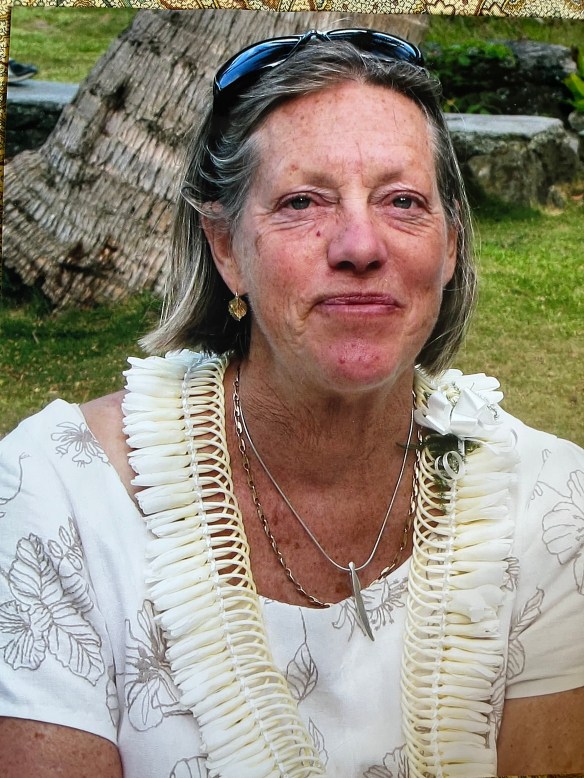
Tai Chi instructor Vince Lasorso spent hours weekly with Bonnie Mitsui the last two years of her life. She came to him with a cancer diagnosis, and told him that she was ready to die. Due to several severe strokes, she had persistent pain in her arms and legs and had years ago switched her dominant hand, painting and working primarily with her left. She had accomplished much with her influential experiment, Turner Farm, both on the farm and in the region. And had overcome significant emotional and psychological barriers from losing her mother and inheriting wealth at an early age. She had reconciled with her son and met her grandchild before she died and this provided her great comfort.
Bonnie Mitsui will be remembered as the founder of Turner Farm, a local organic Community Supported Agriculture farm, where literally hundreds of people worked over the years as part of a number of CSAs and as interns training to become farmers in their own right. Professor Alan Wight has noted that there were two nodes of farmer training and visionary work that helped to build a vibrant local and organic food economy in Cincinnati and Turner Farm was one of them.
That it was built by a woman with no previous farming experience who could have lived anywhere in the world and done anything she wanted with her inherited wealth, is a testimony to the vision she had and the courage she had to pursue it. The farm in Cincinnati was a place she mostly loved but it also felt overwhelming at times.
She loved the land, the animals that lived on the land and that so many people loved being there as well. She spent hours in her studio in the evenings and on weekends painting, drawing and doing woodcuts, almost all of them scenes from the farm. Her son, Chuck Mitsui, thinks her art was as much therapy as expression.
The farm was where her heart was. She told a friend shortly before she died, “When I first saw this place, I was drawn to it. When I first came to this place, I knew I was home. Having this farm, and having the ability to do anything I want with it, is a gift.” The small white farmhouse was different than most of the stately mansions of the Indian Hill suburb. And that was partly what she loved about it, in addition to its location at the end of a lane. The lane was the first thing visitors and she saw, not the house.
Those of us who knew her both admired and feared her. She was a very strong-willed woman.
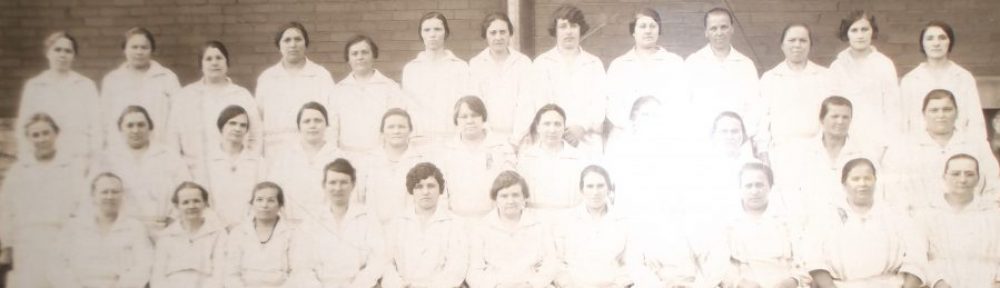
Bonnie’s mother, Betty Stephenson Crudgington, died when she was twelve. She was tall and modeled some. And she, like her mother, was an accomplished horsewoman. No one I have spoken with knows much about Bonnie’s mother; she did not talk about her that much. But it seems Bonnie and her mother had a loving relationship and she was a bit of a buffer from Bonnie’s grandmother. A friend and former farm manager of Turner Farm, Mike Steele, said that Bonnie deeply grieved the loss of her mother, mourning under trees on her grandmother’s land. Serena Stephenson, her cousin, was told that her aunt’s cancer and treatments were horrible. Bonnie was raised by her grandmother, Mary Stephenson LeBlond, after her mother’s death.
And her grandmother could be mean and strict, according to Serena. Others smile when asked about Mary Stephenson LeBlond and note that she knew what she wanted and she got it. Just like Bonnie, they often add. Serena and Bonnie agreed that their grandmother built character. Stephenson spent decades caring for her grandmother’s property and horses and eventually her in her old age. As an adult, Bonnie learned how to stand up to her grandmother, to play her mental game. But first Bonnie had suffered doing things her grandmother’s way: swimming lessons in an ice-cold pool as a young girl and hours-long fox hunts in very cold weather.
Lasorso said that Bonnie was never sure that people were with her for herself or her money. Many who worked closely with her confessed to loving her and being loved by her, particularly in the last decade of her life. And her beautiful funeral was a testament to the community she had built.
In trying to reconstruct her life after her death, it seems that she, like her grandmother before her, achieved a level of freedom and fearlessness that was unusual.
While all three women lived within a patriarchal society, they also sought to lead in arenas that had long been dominated by men: fox hunting and horse racing for Bonnie’s grandmother and farming for Bonnie.
Bonnie’s grandmother became the Master of the Camargo Fox Hunt in 1971, the first woman to earn that position. She also owned Jay Trump, the only American-bred, -owned and -ridden horse to win the Grand National steeplechase in Aintree, England in 1965. It was and is the most prestigious steeplechase race in England. The equivalent race in the U.S. is the Maryland Hunt Cup. These courses were sufficiently different and rigorous to make training for both very difficult. Jay Trump also won the Maryland Hunt Cup three times. She and Bonnie were in Aintree when Jay Trump and his jockey, Tommy Smith won. As a result, they met the Queen of England. Prior to this investment, LeBlond had no experience in horse racing. Her son, Edward, however, was very involved in racing and horse breeding in Virginia.
All of these are possible reasons that Bonnie embraced much that was different from her family’s background, including Japanese language and culture. After equine boarding school in Virginia and then college in New York, she went to live in Japan and then worked for a Japanese language newspaper in New York. It was there that she met her husband Yoshiaki Mitsui. They lived in California with their young children, Natsu and Chuck. But it was an unhappy marriage and they divorced.
In 1992, her children now adults, Bonnie returned to Cincinnati to figure out what to do with the land her grandmother had owned, some of which had belonged to the Turner family. She convinced her uncles it should not be developed and bought it from them. In 1993, she and her daughter, Natsu, drove across the country and “moved” into the white farm house, furnishing it from her grandmother’s house.
As a child, she had been surrounded by farmers or people growing food on others’ land. Indian Hill was still the site of many large-scale gardens and a few working farms in the 1950s and 1960s. Before World War II, her grandfather, Sam Stephenson, had established Meshewa Farm to be relatively self-sufficient with dairy and Angus cattle, vegetable gardens, fruit trees, and orchards. Her grandmother had fed her food from her own gardens. And when she lived in California, she had access to fresh, organic food. She, like her forebears, found land valuable for its vastness, messiness, and ability to grow plants that produced nutritious food.
She thought she knew the best way to eat and grow food and wanted to convince as many people as possible about it. A local newspaper article from 1997 noted, “Like it or not, the world will hear from Bonnie Mitsui. The fast talking, highly opinionated organic farmer from Indian Hill gives anyone who wanders too close no choice. While other vendors hawk only foodstuff, the irrepressible Ms. Mitsui outlines her platform on food and life.”
With help from neighboring farmer, Billy Grob, Bonnie planted her first farm. She also had help from men at Greenacres Farm and the Camargo Country Club and some farmers whom she hired and her cousin. The first CSA started in 1995.
Those early years were very difficult. Bonnie found it almost impossible to find a farmer with whom she could work. She had a strong sense of how to do things. Once a troublesome rooster was thrown into the pig pen. Another time four suckling pig that Serena had been caring for were taken to her kitchen for a new recipe, without any warning.
Melinda O’Briant turned out to be the perfect match. She had a degree in horticulture, her own sense of how things should be done and respected Bonnie. The latter was mutual. Melinda stayed on the farm until 2025 and helped her run the vegetable Community Supported Agriculture (CSA) and a flower CSA.
Bonnie ran the only CSA in the area that required sharers to work in the fields. It was two hours per week for 22 weeks. As part of a family that did that for ten years, I can attest to the fact that the requirement was significant both in terms of time spent but also in terms of what one learns and how one comes to appreciate the labor involved in those tasty tomatoes or pungent basil. These were Bonnie’s twin goals. In fact, that labor spawned a lifelong interest in and investment in agriculture, its history and future for me.
And she wanted community on the farm. In addition to the CSA labor, she held seasonal events for hundreds of people. One was a Maypole festival. All year long the maypole with the beautiful colored ribbons adorned her front yard. And she celebrated the winter solstice with caroling, tree trimming, a huge bonfire and pig roast. Perhaps the most talked about part of the event was the real candles on the Christmas tree. A former CSA member, Jodi Harris, recalls telling her husband how much she loved the real candles on Bonnie’s tree after a solstice party. He then tried to buy some for her for the next Christmas, but could not find them for sale. So, Ricky went with his wife to the next solstice party and told Bonnie he was having trouble finding the Christmas tree candles. Bonnie took some candles off the tree and gave them to Ricky.
Bonnie, like her mother and grandmother before her, loved horses. Horses were at the center of the development of the Village of Indian Hill which boasts miles of riding trails.
She had ridden in fox hunts all over the world with her grandmother as a child and then again ridden horses in California. When she returned to Ohio, she began using horses for farm work and transportation. She learned from Amish in northern Ohio how to drive a horse for farm work.
Much of the work is still done by horse power rather than machines. The farm continues to offer lessons to those interested in draftsmanship.
Bonnie undertook week-long horse and buggy camping trips in Kentucky and Ohio every summer. She rode horses to the bank and rode horse-driven buggies in Fourth of July parades in Indian Hill and Madeira for years in the 1990s and early 2000s.
Bonnie was a significant philanthropist in the region. She supported a large number of organizations that were trying to promote organic, local food, including the Ohio Food Connection, the Civic Garden Center’s community garden project, Ohio Ecological Food and Farming Association, and Granny’s Garden in Loveland. Historic Findlay Market in downtown Cincinnati that now has a robust local farmer shed thanks to her efforts.
A bookkeeper and assistant, Mary Steele, who worked with her for the last six years of her life, noted her willingness to support people and their ideas with her money. She recalled that Christmas was a much-anticipated time to give gifts to friends and family. She particularly supported women with ideas. Mary Joseph, who worked for Bonnie for six years and still works at the farm, noted, “If a woman came by and had an idea, she always seemed to support women.” I know only a fraction of her generosity. And this fraction has made a large impact. The Cincinnati that I live in has a robust local and organic food scene in large part thanks to the fearless and philanthropic efforts of Bonnie Mitsui.
She eventually put the farm in conservation easement, reflecting her philosophy that no one at the end of the day should own farmland. She referred to herself as a tenant farmer for this reason. Joseph noted that the peace she felt on the farm but more than that she loves the farm because “of what Bonnie did and left for others in her gratitude, in her giving herself to other people, for her to have left all of this.”
In an obituary, a friend noted Mitsui was a remarkable, renaissance woman who was pragmatic, frugal and grasped situations quickly. He went on, “She was fearless in trying new ways, absolutely fearless.” My small part of the world is much better as a result.
SOURCES for this biography include interviews with more than two dozen people related to or close to Bonnie Mitsui, articles and books about her accomplishments with Turner Farm, as well as books about Jay Trump and Indian Hill history. This is part of a larger forthcoming book project.
For more information, contact Kathleen Smythe, smythe@xavier.edu.
 Jeannine Vegh