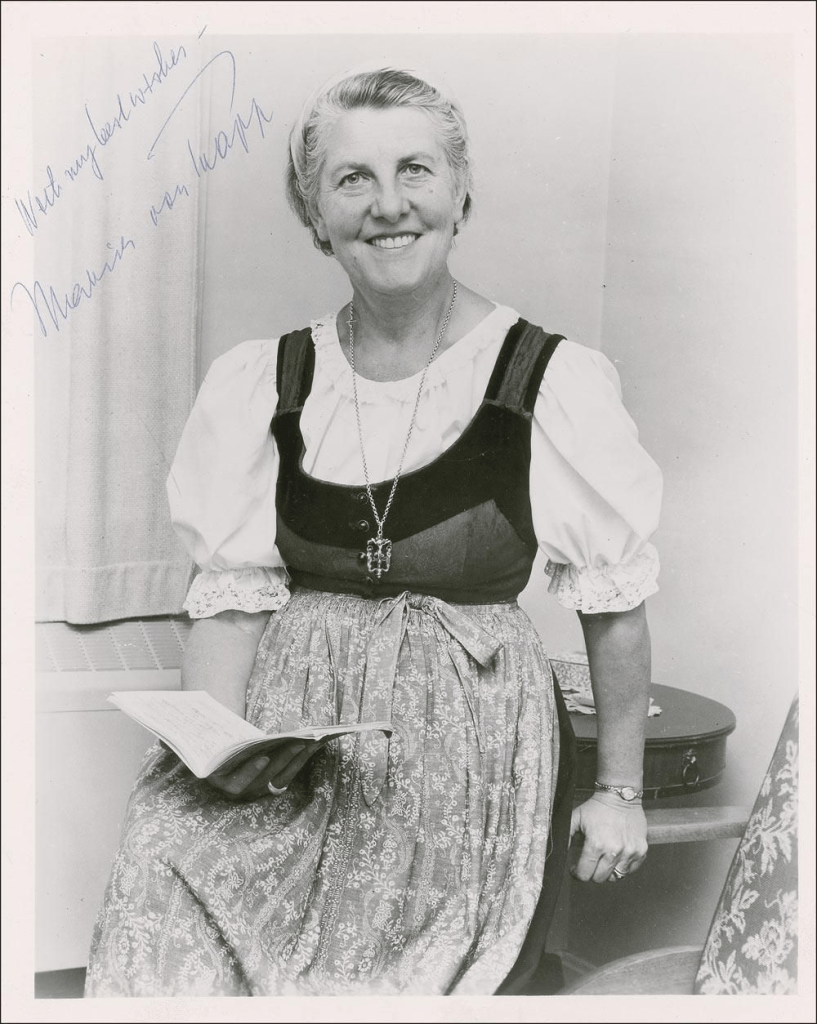
Of course you want to believe that the von Trapp family walked over the mountains onto a plane and came to America. Not really the case. I read the book Maria by Maria von Trapp recently and got a different sense of the Sound of Music. Firstly, they did not make millions off of this movie, they gained $9K after she sold her rights to a German film company, prior to Hollywood knocking on her door. Sadly, Hollywood doesn’t care – no surprise there – about taking over someone’s life. Even better when they reap all the rewards and gain 100% profit. Maria had no idea that her families story would generate millions either. They needed money, which was the case for many years before the Trapp Family Lodge began to really take off in Stowe, Vermont.
Maria may have been seen as too strong of a woman by her family – the sense I would get from a mention she makes at the tail end. I wondered about the fact that she rarely mentions them in her book, though I have not read her first book which was the Story of the Trapp Family Singers. Perhaps there I would learn more about each of the children. In this book, we first learn of Maria’s life pre and somewhat of the Sound of Music “life story” and then it stops and we learn about post-Sound of Music. And, of course, the movie is a historical fiction based on their family but it is not the real story. She doesn’t mention anything about that cemetery scene that still haunts me to this day while I am watching it for the nth time. “Will they escape????”
Maria’s personality pre-Abbey and at the convent sound a little like Julie Andrew’s portrayal. Though, she didn’t mention going in the hills to sing songs and twirl around with flowers in her hands. What she does mention though, very diplomatically, is Mary Martin’s relationship with her vs. Julie Andrew’s. Mary and she got to know each other at the lodge and Mary sent her a gorgeous gown for the opening night theatrical performance. Julie did nothing. She was not invited to any of the movie release parties but did beg to see the screening. She did not want her husband to be portrayed so unconvincingly. She loved him very much.
After her husband, the Baron dies in 1947 – seven years after they come to the U.S., she will go off to Papua, New Guinea where a few of the (now adult) children are already there as missionaries and spend a year (I believe it was) though the children stayed much longer. It is so fascinating to hear her escapades along this third world country area, including conversations with women in a cannibal tribe. She is quite the storyteller as she reveals different observations as well as the gift giving that took place along the way. In fact, I became a little lost in the third world stories and had to keep reminding myself that I was reading a book about Maria von Trapp.
I like the feel that I get for the Baroness. She strikes me as a very brave, strong, independent thinking woman. She was devoted to her husband and their three children, as well as the seven stepchildren. By the way, the stepchildren’s names were really: Rupert, Agathe, Werner, Hedwig, Johanna, Martina and Maria Franziska. She managed the Trapp Family Lodge, which began as a singing camp, for a great many years until her youngest son Johannes encouraged her to step down so that he could take the lead. It is now co-Directed by his two children. He is the only child that remains alive to this day.
While listening to her speak about the family lodge and its creation, I was mesmerized while taking an internet tour of the facility. This family really thinks of everything! Not only are they nestled in the mountains so that they can become a wonderful ski lodge, they are a wedding venue as well. There are so many other sports you can be involved in including horse riding, swimming, and cross country skiing to name a few. They also raise their own hens, as well as other animals and have a garden for growing vegetables and herbs used in the cooking of the gourmet meals.
Toward the end of the book, Maria is persuaded by her daughters to attend a spiritual retreat and is “saved” by a group of people there. Her life of piety continued from convent to mother to grandmother or up until the end.
Maria died on March 27, 1987 at the age of 82 years old, near the lodge in Vermont.
 Jeannine Vegh